Polish Traditional Folklore: The Magic of Time by Anna Brzozowska-Krajka
book review

As some of you may remember, I made a commitment to read more Slavic culture literature in English so I can recommend you some decent reading. I took the commitment very seriously and — as it always happens when you follow the path of your ancestors — found a true treasure: a monograph about the Slavic view of time by Polish author Anna Brzozowska-Krajka, translated by Wiesław Krajka.
The book was published — in English — in 1998, which made reading it even more enjoyable, because there was no need to painstakingly crawl through the oh-so-many politically correct caveats plaguing modern English social-studies literature. However, if you are one of those sensitive readers, do be advised that the book does not describe a person, but a man; and does not call folk’s understanding of time alternative, but primitive. So, brace yourself.
The downside of the book being nearly 30 years old is some outdated elements, such as stating the existence of worship of the White God and Black God by Western Slavs, which is currently a heavily contested idea, widely considered fakelore and rejected by many, if not most scholars of Slavic studies. However, if while reading the book you understand the White/Black God dichotomy as a rhetorical device rather than a fact, you will absolutely be able to enjoy the book without feeling contaminated by fakelore.
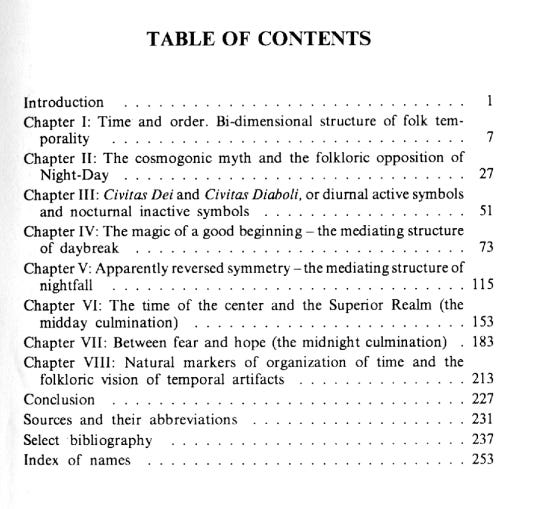
As to the content of the book: In order to study the view of time in Polish folklore, Brzozowska-Krajka analyses many aspects of folklore, both Polish and generally Slavic. This makes her book a very rich source of information about Slavic demonology, magic, rituals, prayers, as well as — which for me was one of the most important aspects of this book — the authentic, pre-industrial, superficially Christianised way of being a human in the world of the Slavs. So, apart from the discussion of time, Polish Traditional Folklore will also treat you to an alternative (other than developing from mice) origin of bats, more than a few examples of the power of the Slavic słowo (word), a few Slavic ways of fighting vampires, and even details of the birth of the Antichrist (spoiler alert: it’s hatching).
To give you an idea of the level of insight Polish Traditional Folklore will give you: as you all know, Slavs believed that many particularly nasty demons arise as a result of not completing proper funeral rites for the dead. However, until I read the book I did not know — and quite frankly was not even aware — that the clock on funeral rituals did not start ticking after the death of a person, but actually before this person’s death. The reason for that was that, in the understanding of the Slavs, an individual was nothing without a community. This rule applied to both the living and the dead. So if one died alone, without any living person assisting him or her in dying, this person could not easily pass over to the community of the dead. Due to this way of perceiving an individual, dying alone — particularly during the night — was seen as the worst possible death, virtually guaranteeing that the deceased would not be able to pass over easily to the Afterworld and would for sure end up as a living dead, wandering alone around the living.
To top that — as if it was needed — the book is available for free on archive.org and, vocabulary-wise, is not terribly difficult to read. You will likely have to look up a few fancy words, such as “exegetical” or “soteriology,” but other than that, for an academic publication it is a relatively easy read. So there is no excuse: if you are serious about embodying the Slavic way of being in your life, you simply have got to read Polish Traditional Folklore: The Magic of Time by Anna Brzozowska-Krajka.