

Rodnovery 101: The Gods
Understanding the Slavic Gods: evidence, caution, and practice

There is no doubt that our pre-Christian Pagan ancestors worshipped Gods, although it remains debated whether they venerated one supreme God, one superior God with several lesser Gods, several Gods of roughly equal standing, or some combination of these.
One thing any modern follower of Slavic Native Faith must keep in mind is that Slavic Paganism has never been uniform. While the broad forms of worship were roughly similar across Slavic groups—nearly universal veneration in holy groves, outdoor rituals, and celebrations of the solar cycle—the specific practices differed (and still differ) greatly from one Slavic group to another.
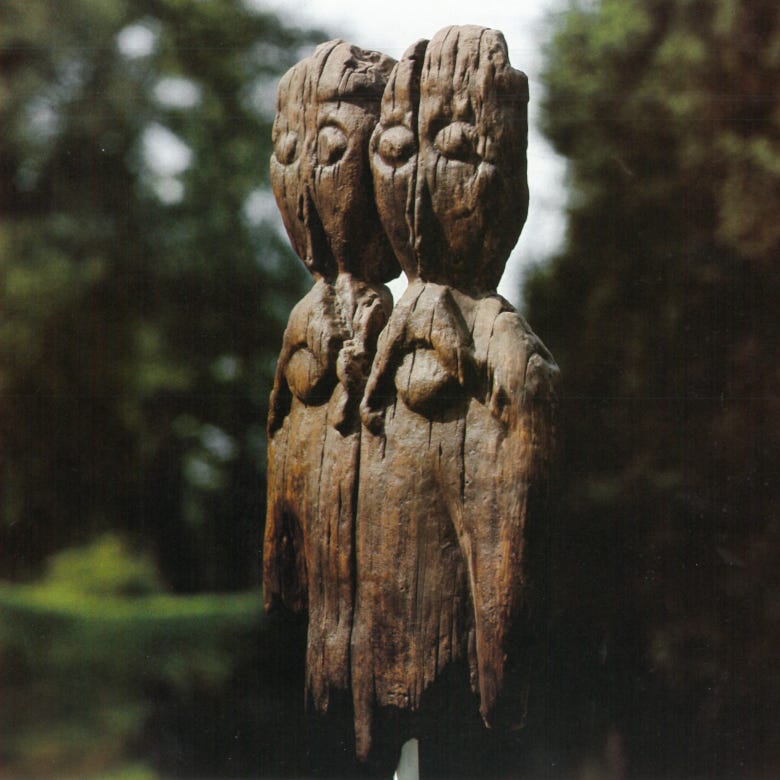
The Gods worshipped by our pre-Christian ancestors were among the first targets attacked and destroyed during the process of Christianisation. The historical sources, preserved mostly by Christian chroniclers, deliberately distorted original Slavic Paganism, demonising and vilifying it. These chroniclers were so relentless in their denigration of the Slavic Gods that some scholars, such as Erwin Wienecke, suspected the idols of Slavic Gods were not actually multi-headed but were portrayed that way by Christian writers to further demonise Them. This theory was largely abandoned after archaeological discoveries confirmed the existence of genuine multi-headed idols among pre-Christian Pagan Slavs.
For many years, studies of pre-Christian Slavic Pagan religion were influenced by evolutionary approaches to the history of religion. These older paradigms (prominent in 19th- and early 20th-century scholarship) viewed religious development as linear, progressing from “primitive” forms such as animism through polytheism and culminating in monotheism as the most “advanced” stage. Scholars such as Mircea Eliade and Georges Dumézil also shaped the field through their comparative Indo-European frameworks, which often presented Proto-Indo-European religion as a unified whole that fragmented and evolved differently as the ethnolinguistic groups (Slavic, Germanic, Baltic, and others) diverged.
As a result, over roughly two centuries of scholarly efforts to study pre-Christian Slavic Paganism—based on very scarce and often biased sources—researchers have proposed numerous competing models of what that religion looked like. Because many of these scholars were shaped by older evolutionary and comparative paradigms, it became common to reconstruct detailed pantheons and assign clear attributes to the Gods in ways that would neatly fit the framework of “standard” polytheism familiar from Greco-Roman, Norse, or other well-documented traditions.
Consequently, the literature on pre-Christian Slavic Paganism is filled with recurring archetypes: divine twins, light/dark or order/chaos dichotomies, eschatological narratives, wars between the Gods, supreme deities, death-bringing mother figures, and similar motifs.
On top of that, many amateur enthusiasts of Slavic Native Faith, often unaware of the contested methodologies that have shaped reconstructions of pre-Christian Slavic Paganism for roughly two centuries — as well as the ongoing discourse within academic Slavic studies — treat every scholarly reconstruction as established fact. They then synthesise these reconstructions (or already uncertain and heavily biased pantheons), project their own modern biases onto them, and produce even more elaborate imaginary “Slavic” mythologies.
These creations, designed to increase virality, are frequently illustrated with fantasy-style art — nowadays often AI-generated. As a result, modern internet “Rodnovery” or “Slavic Pagan” spaces can quickly turn into echo chambers of fakelore, where AI-generated “lore,” gnostic visions, and personal revelations replace rigorous evidence and critical thinking.
Any serious aspiring follower of Slavic Native Faith should be aware of these issues before turning to non-academic internet sources. It is essential to remain critical at all times: validate claims whenever possible by checking the original sources, and remember that virtually every statement about pre-Christian Slavic Paganism — even when made by a respected scholar — is not an established fact, but rather a point of view: an interpretation based on biased, fragmentary, or uncertain sources.
What we know (pretty much) for sure
The least contested elements of pre-Christian Slavic Paganism include the widespread worship of nature: individual natural elements such as trees, rivers, and rocks, as well as larger sacred ecosystems like holy groves. It is likely that these elements of nature were sometimes personified. Non-Slavic sources, for instance, describe Slavic reverence for rivers and “nymphs” (Procopius of Caesarea, 6th century), while later East Slavic texts mention vily (or wiły), nature spirits akin to nymphs or fairies.
Different groups of Slavs worshipped different Gods, and this diversity appears to have been significant. In Kievan Ruś, for example, when Vladimir the Great attempted to introduce a more unified pantheon of six (or seven) Gods around 980, the reform did not take root — although the exact reasons remain unknown.
The Gods were likely tied closely to specific tribes or tribal confederations. This tribal character helps explain why Svarozhits (also known as Radogost or Redigast) was the central deity worshipped in Rethra, the political and religious centre of the Redarii (a Polabian Slavic tribe). Other tribes and temple centres focused on their own prominent Gods, such as Triglav, Gerovit, Svetovid, or Rugivit.
What Is Plausible, but Not Certain
It seems that the Slavic Gods each had particular domains or functions that represented Their primary sphere of influence or power. Examples include war and military victory (a role shared by most major Gods of the Polabian Slavs, as well as Perun in Kievan Ruś), the chthonic realm and cattle (Volos/Veles in Kievan Ruś), and childbirth together with fate (the Rožanitsy/Rozhanitsy, and possibly Rod). If this is accurate, the Gods were not all-powerful in the sense of the omnipotent Christian God; each appears to have operated within specific areas of responsibility.
As for how pre-Christian Slavic Pagans addressed the Gods, it appears that They were often invoked using descriptive bynames or epithets rather than (or in addition to) proper personal names. Well-known examples include Dažbog (“He who Gives”) Triglav (“the Three-Headed”), Svetovid (or Svantovit, “the One Who Sees the World” or “Holy Lord”), and Volos (“the Hairy One” or “the Woolly One”). Whether the Gods truly lacked proper names or whether Their personal names were simply taboo or rarely recorded remains uncertain.
Modern Evidence-Based Practice of Slavic Native Faith
Given the great diversity and strongly local or tribal character of pre-Christian Slavic Paganism, a sensible — and, in my view, wise — approach is to ground your personal worship in your own ancestral or regional tradition, or at least in one clearly chosen local form of Slavic Paganism.
For example:
If your family roots lie in Russia, Ukraine, or other East Slavic lands, you might focus on Gods such as Rod, the Rožanitsy, Veles, or Mokosh.
If your heritage is West Slavic (Polish, Czech, Slovak, or Polabian), consider Svarog, Svetovid, or Živa (Siva).
If you come from South Slavic roots, you may wish to honour the God whom Procopius of Caesarea described as “the maker of lightning” — widely interpreted as Perun, even though that specific name appears only in East Slavic sources.
A reasonable pan-Slavic choice could be Dažbog or Svarog/Svarozhits, but with the clear understanding that we cannot establish with certainty whether They were one God, two Gods, or three separate Gods (Svarozhits possibly being a diminutive or epithet of Svarog). Their domains, likewise, remain scholarly hypotheses rather than established facts.
An even wiser path, however, may be to set aside specific divine names and reconstructed domains altogether. Instead, focus on the direct worship of natural elements and forces — the holy groves, rivers, sky, fire, and earth that our ancestors venerated. During prayer or ritual you can address Them using descriptive bynames rooted in Slavic language, such as Dažbog (“He Who Gives”) or Svetovid (“the One Who Sees the World”). Alternatively, you can use simple, heartfelt descriptors: “Gods of my ancestors,” “Gods of this land,” “Gods of the sky and thunder,” or simply “the Old Gods.”
This approach stays closest to what we can confidently know, avoids the pitfalls of fakelore and over-reconstruction, and allows your practice to remain authentic, personal, and deeply rooted in living landscape, which is how our pre-Christian Pagan ancestors worshipped their Gods as well.
Ultimately, Slavic Native Faith is not about reconstructing a perfect pantheon, but about re-establishing a living relationship with the sacred forces our ancestors knew. Start small, stay critical, and let the land fill you with awe — the same awe that inspired your ancestors, gave them strength to keep living through the generations, and that ultimately the one that flows through you.
Very enlightening, thanks for writing
What Ivanits writes about Rod as god, does this attribute come from the later, Christian concept? When it's about the etymology he might be just a personification of the family lineage, or a symbol of all our people, like folk (rod- narod). Which is worth respecting or even veneratating, especially in the modern times, when people try to find their identity, but… although he is mentioned in the sources with Rozhanitsy, it doesn't seem like he was veneretaed as deity, maybe like a minor spirit. Surely he wasn't a chief god, that's Rybakov’s invention…