

Slavic calendar 1/2
Translation of fragments of Spiritual Culture of the Slavs by Kazimierz Moszyński

Translation of fragments of Spiritual Culture of the Slavs by Kazimierz Moszyński
Translation by Witia
Headings by Witia (in the original text paragraphs are numbered)
In the original ‘out’/’ours’ is used sometimes as ‘in Western/modern world’ and sometimes as ‘in Polish/Poland’. In translation I marked ‘Polish/Poland’ meaning in square brackets.
For clarity now archaic Little Russia is translated as Ukraine and Great Russia as Russia.
Project Witia is all about preserving: culture, tradition, language, with no judgement and no bias. This is why in translation I kept the original, nowadays considered ‘politically incorrect’ vocabulary (e.g. ‘uncivilized’, ‘exotic’) to preserve not only the knowledge, but also the point of view of Kazimierz Moszyński.
Translation from K.Moszyński, Kultura Ludowa Słowian, część II, Kultura Duchowa, Kraków 1934
Translation pages 138-145
The seasons
Nowadays, the beginning of spring, summer, autumn and winter is often associated by Slavic peasants with a saint’s day, i.e. a specific date in the calendar. However, very old traditions have been preserved in some countries. For example, for Serbo-Croats from certain regions of Yugoslavia, spring begins with the sprouting of grass, and summer with the appearance of the first fruits. Bulgarians count the beginning of spring from the day they see the swallows return; the middle of spring from the day the cuckoos arrive; and the beginning of autumn from the departure of migratory birds. However, the old beliefs have been preserved much better in Polesie1, where the struggle between the traditional beginning of each season and that imposed by the modern calendar is most evident. “They say,” muses a farmer from Rzeczyca in Polesie, “that spring begins on the day of the 40 martyrs2 ; that may be so, but the beginning of true spring is only when thunder rumbles and warm rain falls, when the ńèleń3 turns green and the nightingale sings.” “They also say that summer begins on St. Maciej’s Day4 ; perhaps, but true summer only begins when the grain sprouts”5 . Similarly, for him true autumn begins with night frosts, and true winter with the appearance of snow and frost. How vividly we are reminded here of the definitions of the beginnings of the seasons given by various exotic peoples: spring, for example, begins for the natives of central-northern Asia with the first grass; winter with the first snow, and so on.
Although the Slavs have distinguished between four main seasons for centuries, there are certain indications that their distant ancestors distinguished only two main seasons: cool and warm (i.e. winter, including late autumn and winter proper, and summer, which was understood to mean our spring and summer); This may be indirectly supported by some very interesting meteorological divinations6 as well as data concerning the Germanic peoples. This would be the situation we find today, for example, among the Siberian Teleuts, who, if we are to believe Georgi7 “divide the year into winter and summer. Summer begins with the melting of the ice and the first grass, while winter begins with the first snow; each has 6 moons, while the 13th (moon) is lost due to the unspecified dates of the New Year.8
The Slavs had two names for spring: vesna (cf. Lithuanian vasara ‘summer’, Old Indo-European vasantáh ‘spring’, etc.) and jarь (cf. e.g. Avestan yār- ‘year’, Gothic jēr ‘year’9 , but we are not sure whether any of these terms originally meant summer, as the word lěto is of relatively late, newer origin (similar to esenь ‘autumn’). The name for winter (Slovak zima) is as ancient as both names for spring (cf. Lithuanian żëmà ‘winter’, Old Norse himáh ‘cold; winter’, etc.).
In addition to such expressions as “in winter”, “in summer”, “in early spring”, etc., Slavic peasants also use other expressions derived from the names of agricultural activities associated with the period of time in question. Thus, it is often said (here or elsewhere): “at harvest time” (or even more precisely — “at the very harvest”), “during digging [e.g. potatoes, TN]”, “during grape harvest”, “during sowing”, etc.10 These “small seasons” are also named after natural phenomena, i.e. those characteristic, not very long periods of time, not strictly separated from the rest of the year. Thus, both in Russia and at the other end of the Slavic world, among the Montenegrins, the period when the leaves fall from the trees is called listopad [literally: falling of the leaves, TN](among the Russians, a different form of this name: according to Dal, listopad also means ‘autumn’). The last days of February and the first days of March, when the weather in Montenegro is commonly very bad, are called sječ by the local inhabitants, a term which they also use to describe ‘bad weather’ in general (cf. our [Polish] siekawica ‘violent rain or hail with wind; a storm with snow or rain’). All these are remnants of age-old habits, and it is thanks to such distinctions between the most characteristic and long-lasting phenomena or groups of phenomena that the system we have just discussed developed, distinguishing first — as far as many peoples of northern Eurasia are concerned — two, and later three and four main seasons, which filled the entire cycle of annual changes.
Lunar vs solar cycle
Without going into further detail here, we will note in general that although the distinction between seasons preceded the concept of the year itself, this concept is also very old. As comparative ethnography suggests, for thousands of years there have been attempts to reconcile the lunar, or monthly, calculation of time with the solar, or annual, calculation by subordinating the smaller, i.e. lunar, unit of time to the larger, i.e. solar, unit. The fact that we see these attempts in many peoples inhabiting the Earth speaks to their antiquity. And everything would have gone smoothly, even within primitive cultures, if the lunar unit of time had fit a certain number of times into the solar unit, in other words, if the duration of the year, expressed in days, had been exactly divisible by the duration of the month. However, as we know, this is not the case. The solar year has 365 days, 5 hours and 49 minutes: this period is nearly 11 days (10 days and 21 hours) longer than 12 lunar months, but more than 18 days (18 days, 15 hours and 44 minutes) shorter than 13 of those months.
Of course, uncivilized peoples could not discover these complexities. This led to errors in reconciling the two units of time, which still persist today in Slavic villages. For a Croatian peasant from Samobor, the moon “rejuvenates 13 times a year”; for many Polish peasants, the year also has 12 calendar months, but 13 lunar changes, etc. Such beliefs can naturally lead to a 13-month year. Indeed, the 13-month year is used by many peoples. Apart from the Estonian tradition (according to which the year used to have 13 months, but the landowners cleverly stole or hid the thirteenth month in order to pay taxes for one month less), the 13-month year is actually used today by the Ostyaks (Ugrians), the so-called Yenisei Ostyaks, the Altai, the Soyots and other “semi-wild” peoples of northern Asia. On the other hand, there are also many uncivilised peoples who use a 12-month year. It is obvious that the inaccuracy of both the first and second concepts must, by their very nature, reveal itself from time to time, and then, as we shall see below, automatically force corrections. Before we move on to this issue, however, let us first emphasise that among many, or rather almost all, peoples of North America and Eurasia, and to a lesser extent also among the peoples of Africa, the individual lunar months have been given their own names, and let us familiarise ourselves with the relevant terms used by the Slavs.
The creation of separate names for the months, even by peoples with a low level of cultural development, becomes understandable when we consider, on the one hand, how important the lunar month is as a measure of time and, on the other hand, how important in human life are the changes discussed above, which occur throughout the year in groups of phenomena. It should come as no surprise that we find separate names for lunar months among the Ainu, Eskimos, Chukchi, Tungus, Samoyeds, Voguls, etc. Most commonly, these names are derived from natural phenomena characteristic of a given month, from hunting, agricultural and other activities, etc. For example, among the Teleuts, the first month of their year, corresponding to our April, was (according to Georgi) named after the squirrel, which appears in large numbers at this time; the second month was named after the plough; the third month was named after the plant Krythroniumdens canis L. [currently: Erythronium dens-canis, also known as dog’s tooth violet, TN], whose edible roots are dug up at this time; the 6th month — from the harvest; 7th — from threshing; 11th — from the wind, etc.
And the Slavs — contrary to the erroneous beliefs of some philologists who are not familiar with comparative ethnography — must have had names for the months since time immemorial. Their native, old terms, some of which have survived to this day in the mouths of the people or in the monuments of ancient literature, certainly did not originate solely on the model of those brought by Roman or Christian civilisation, nor were they originally exclusively names of the so-called small seasons, completely independent of the lunar calendar; on the contrary, originating from natural phenomena or human activities characteristic of given periods, they have long served mainly the moons falling within those periods.
Naming of months/moons
The most thorough of the very few earlier articles devoted to the names of months among the Slavs is Fr. Miklosich’s extensive comparative treatise “Die slavisehen Monatsnamen* (Denkschriften d. k. Akademie d. Wissenschaften, vol. 17; 1868, pp. 1–33). L. Niederle (SSOK, vol. 8, issue 2, 1925, pp. 746–750), but he did not take into account some important ethnographic sources (such as J. Kovateva; SbNU, vol. 30, 1914, p. 74 ff.). Among the most recent contributions, mention should be made of F. Spahy’s “Naš narodni nazivi mjesici u turskim kalendarima iz sedamnaestog vijeka” (Glasnik Zem. Muz. u Bosni i Hercegovini, vol. 42, 1930, pp. 185–205).
L. Niederle, attempting to compile Slavic names of months, found that although many of them are used in numerous countries, almost each one has a completely different meaning, referring to one month for some Slavs and a different month for others. However, he did not notice that this variability in meaning, when it comes to the dozen or so names that are most important to us here, i.e. the oldest and most widespread names, in most cases occurs in a striking way only within the boundaries of two neighbouring months. As far as I know, prosinьcь refers or referred exclusively to the 12th or 1st month of our modern year; sěčьńь — only to the 1st or 2nd; berzьńь — to the 3rd or 4th; travьńь serves as many as four consecutive months (3rd, 4th, 5th or 6th), but květьńь again only the 4th or 5th; červьńь — 5th, 6th or 7th, lipьńь — 6th or 7th; sьrpьńь — 6th, 7th or 8th; versьńь— 9th month (only in Czech — 7th or 8th month; rujьńь. or rjujьńь — 9th or 10th; pazdernikь — 10th month; listopadь — 10th or 11th; studenь or studьńь — 11th, 12th or 1st; grudьńь — 10th, 11th or 12th (exceptionally, in Slovak, hrudeň means ‘9th month’, and in Czech, hruden means ‘an intercalary month11 between the 12th and 1st’, or the 1st month). In short, of the 14 names cited, only 6 cover more than 1 or 2 neighbouring months, and even of these six, versьńь gives completely local and probably quite random semantic deviations. The variations in the meanings of individual Slavic names of months are not surprising at all, as they are thoroughly justified by the fact that: 1) only a few of the phenomena that give names to months last only one moon or more part of a moon, 2) the dates of many of these phenomena shift slightly backwards or forwards depending on climatic fluctuations and the geographical location of a given country, etc.12 , and finally 3) the disproportion between the monthly (lunar) and annual (solar) units of time must have caused the names to shift forward or backward, depending on whether it was a 13-month or 12-month year13 . Particularly interesting in this context is the use by a given people of one and the same name for two consecutive months with the addition of qualifiers: small and large (cf. e.g. in Bulgarian — golěm sěčko ‘1st month’ malьk sěčko ‘2nd month’; in Serbo-Croatian and Slovenian mali traven ‘3rd or 4th month’, veliki traven ‘4th or 5th month’; mali serpen ‘6th month’, veliki serpen ‘7th month’; in Czech maly červen ‘6th month’ červen veliky ‘7th month’, etc.). Among other places, this way of naming neighbouring months is quite common in the Polish mountains. (…)
Summer moons/months
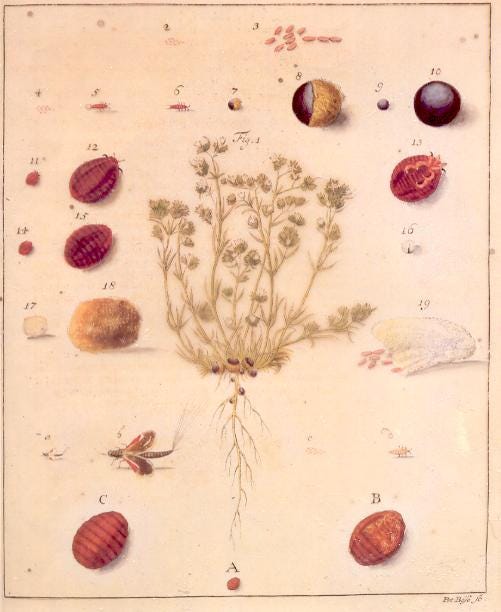
A more detailed review of Slavic month names — which we cannot do without here, and which, despite its conciseness, unfortunately takes up a lot of space — will begin with June, July and August, as the placement of these months in time can be determined with relatively greater accuracy14. The term červьńь15 [in Polish czerwiec, June, TN] has already been discussed in Part I of this work [Part I of Kultura Ludowa Słowian, not in this translation, TN]. It was emphasised there that the collection of larvae of Polish cochineal (Porphyrophora polonica) [in Polish language called czerw or czerwiec, TN] , from which the aforementioned name was derived, took place in the areas of Poland and Polesie (and the middle and lower Volga basin) in the 6th month and possibly in the first half of the 7th month. This is consistent with the fact that the name in question is referred to in various Slavic countries as the 6th month, and only exceptionally as the 5th or 7th month.16
Lipьńь17 [in Polish lipiec, July, TN] obviously owes its origin to the flowering of linden trees, which is an important period for beekeepers, and, as we know, the ancient Slavs practiced beekeeping on a large scale. The so-called large-leaved linden blooms (in our country [Poland] and in Ukraine) during the second half of June and at the very beginning of July, while the much more common small-leaved linden blooms during July (and at the end of June): in Russia, except for the western part of the country, only the latter is widespread in forests. Since the name of the month, derived from the name of the linden tree, means the 7th month for the northern Slavs (and the Balts), and the 6th month for the southern Slavs, where the linden tree must bloom a little earlier, the correspondence between the name and the phenomenon to which it owes its origin is almost perfect.
Sьrpьńь18 [in Polish sierpień, August, TN] refers to the harvest, which in Poland and Ruś, except for the north of the latter, falls mainly in the second half of July and August. And here we see a characteristic, quite understandable difference: Bulgaria and Serbo-Croatia generally have their harvest earlier, hence the name sьrpьńь is used there for the 7th month, exceptionally for the 6th, while among the northern Slavs for the 8th. The next moon, versьńь, [in Polish wrzesień, September, TN] took its name from heather (which, like linden, is very important in beekeeping), but this name is poorly attested; we find it among the Czechs, Poles and in western Ruś on the one hand, and among the Serbo-Croats on the other; everywhere it is known, except in the former Czech Republic, where it was used for the 8th and even, apparently, the 7th month, it means the ninth month. (Heather begins to bloom here in the 8th month and is in full bloom in the 9th). — The name versьńь competes with another: rujьńь or rjujьńь19 ; it means ‘the month of rutting, i.e. the rut’ and was derived from the word ruti, rjuti ‘to bellow’, and is known in a similar form to the Lithuanians; among the Slavs, it is used to refer to the 9th or, less commonly, the 10th month. As is well known, the rutting season for elk and deer usually begins at the end of August20 and lasts for a long time. In the old Slavic lands, which were rich in game, the forests must have resounded in autumn in many areas with the loud roaring of these animals, and it is no wonder that this gave rise to the names of the months, especially since during the rutting season, male elks and deer were probably hunted intensively, lured by their voices.
End of part 1 of 2
1Polesie is a geographic and historical region in Eastern Europe, often called one of the continent’s last great wilderness areas or even “Europe’s Amazon.” Polesie stretches across the borders of four countries: Southern Belarus, Northern Ukraine, Eastern Poland, Western Russia, TN
29 March
3An oak tree that retained some of its dead leaves over the winter.
410 June
5I am quoting from the version sent to me by Mr. Cz. Pietkiewicz in a letter; in his second volume of “Polesia rzeczyckie* (in manuscript) there is a slightly different text.
6But of course, this type of divination could have been adopted by the Slavs or their ancestors from neighbouring peoples.
7Johann Gottlieb Georgi, 18th century German-Russian scholar: a physician, naturalist, geographer, ethnographer, TN.
8However, do the Teleuts not have names for the four seasons, apart from this division, or do they not distinguish between them? Georgi does not mention this.
9It is interesting that both names for ‘spring’ (or originally for ‘spring’ and ‘summer’? Or for ‘summer’) seem to refer to brightness, ‘shining’. The indeur. stem *ues-, probably found in the word vesna, means ‘to shine’; while the root in the word jarь ‘spring’ is, contrary to other assumptions, perhaps identical in origin to the root jar- in words such as Polish jarzyć się, Bulgarian jarà ‘glow, light’, Serbo-Croatian jàrkij ‘bright, vivid’.
Bulgarians and Serbo-Croats do not use the words vesna and jarь. They call spring “przedlecie” [before summer, TN](Bulgarian prólět, Serbo-Croatian próljeće; similar words, known to the Northern Slavs, express the characteristic subordination of spring to summer).
10It is worth noting in this connection that the Slavic name for autumn, eseń, is linked by etymologists to Gothic asans, ‘time of equipment, harvest’.
11Intercalary (or leap, embolismic) month is an additional month inserted into certain calendars to keep them aligned with the solar year, TN.
12Compare the following fact as an example. The two months on the borderline between summer and autumn were named by some Slavs after the “rutting season of deer and elk”. Well, let’s say that the rutting season of deer normally begins at the very end of August; however, there are years when its beginning is delayed by a whole month.
13Quite exceptionally, the meaning of a given monthly name has changed due to other reasons. Thus, the Slovaks moved the name grudьńь to the 9th month, because at this time “oráči ourody připravují, hrudy rozrážejí” (Miklosich, l. C, p. 13).
14In the following overview, I do not limit myself exclusively to strictly ethnographic materials, as this is not possible with the current state of knowledge if one wants to give a synthetic picture.
15The form červьńь is continued in the following languages: Bulgarian (5th month), Serbo-Croatian (6th month), Czech (6th or 7th month), Polish (6th month), Moldavian and Old Wallachian (6th month). In addition to this form, there is another form in Polish: czerwiec, which is also repeated in Ukraine (Moldavian červec, čèrveń, čyrveń, meaning either the 6th or 7th month). Bulgarians also have the form crьvenikь ‘6th month’.
16Admittedly, there is another possible explanation for the word červьńь; it may be derived from the word ćsrva, taken in the more general sense of *červ ‘worm’. At least among Georgians, June (6th month) got its name from czerw in the meaning of a maggot,, as in their opinion a lot of these creatures appear in this month.
17The form lipьńь is continued in the following languages: Serbo-Croatian, Slovenian, Czech, Polish and Ukrn; Polish also has an alternative form: lipiec, for which we find equivalents in all Russian languages (in Russia, however, both this and other old native names are no longer in use today).
18Names derived from the old sьrpьńь are used in the following languages: Bulgarian (7th month), Serbo-Croatian (6th or 7th month), Slovenian (7th or 8th month), Czech, Slovak, Polish, Ukrn, Błrs and Rus (everywhere 8th month). The Chuvash have a term similar to the Slavic sьrpьńь - (”month of August*).
19Serbo-Croatian rûjan — 9th month, Slovenian rujan — 9th or 10th month; Czech řijen — as above, Wallachian rjùjeń — 9th month.
20Hence, the Slavs have alternative names for this month: Bulgarian zàrev and Wallachian zarjóv, literally ‘beginning of the roar’ (but in Czech, zaři and zařej mean the 9th month).