

Slavic calendar 2/2
Translation of fragments of Spiritual Culture of the Slavs by Kazimierz Moszyński

Translation by Witia
Headings by Witia (in the original text paragraphs are numbered)
In the original ‘out’/’ours’ is used sometimes as ‘in Western/modern world’ and sometimes as ‘in Polish/Poland’. In translation I marked ‘Polish/Poland’ meaning in square brackets.
For clarity now archaic Little Russia is translated as Ukraine and Great Russia as Russia.
Project Witia is all about preserving: culture, tradition, language, with no judgement and no bias. This is why in translation I kept the original, nowadays considered ‘politically incorrect’ vocabulary (e.g. ‘uncivilized’, ‘exotic’) to preserve not only the knowledge, but also the point of view of Kazimierz Moszyński.
Translation from K.Moszyński, Kultura Ludowa Słowian, część II, Kultura Duchowa, Kraków 1934
Translation pages 145-151
Autumn moons/months
Włodzimierz Matlakowski devoted one of the chapters of his beautiful and valuable book “Zdobienie i sprzęt ludu polskiego na Podhalu” (Decorations and Equipment of the Polish People in Podhale) to the processing of flax into linen. Here is the picture he paints at the beginning: “It is a great, cheerful October [in Polish: październik, TN] day... the shed is wide open... and a dozen or so invited and hired girls are diligently scutching flax... And verse after verse flows, accompanied by the special sound of beech flails and the crackling of crushed flax hurds [in Polish: paździory, TN]... Rays of sunlight pierce the open field, and in their glow, the dark silhouettes of the girls flicker in a golden cloud of dust and crumbs of crushed straw.” Throughout the Slavic world, from the Bohemian Forest to the ends of Siberia, the beginning or middle of autumn is the season of scutching flax, and the clatter of flails and the paździory [flax hurds]-strewn courtyards, barns and even streets are the most characteristic features of this period. The name of the month, pazdernikь1 (with a scope similar to that of the name versьńь), seems quite clear in this light and can be translated simply as ‘the month of flax hurds’2 (cf. Bulgarian pazdèr ‘flax hurds’, Serbian-Croatian pózder, pózdèrka ‘flax hurds’, Slovenian pazdęr, pazdęrje ‘flax hurds’, Czech pazder, Polish paździor, paździerze, etc.). However, there is a dark spot against this clarity. The ancient Great Russians understood the word pazdernikь to mean not only ‘the 10th month’, but also ‘a cold north wind that strips the leaves from the trees’, and even today, in the far north of Great Russia, pazdernik is the north-easterly wind, especially in autumn, which is the coldest. Admittedly, there are very simple explanations for this: 1) the similarity between the names of the month and the wind may be coincidental, or 2) the name of the month may have taken on the meaning of the name of the wind in Ruś due to the common word pazderit, pazdirat ‘to strip, to tear off’ [in Polish: poździerać, TN] and because it referred to the autumn period, when the winds indeed “strip” the leaves from the trees. Be that as it may, contrary to both of these very plausible explanations, one might suspect that, quite the opposite of the second explanation, the original understanding of the monthly name pazdernikь was not ‘the moon stripping leaves from trees’, and that its association with paździory (flax hurds) occurred later and by chance.3
If we were to accept the latter explanation, then the next name we have to deal with here: listopadь4 [literally ‘falling of leaves’ also a Polish name of the month November, TN], strictly speaking, would be a duplicate of the previous one. This name is quite clear as a term or name for the autumn month, not only widely used among the Slavs, but also having or having had exact equivalents in ancient Greece, Ireland, southern Germany, among the Balts, eastern Finns, and the indigenous peoples of northern Asia and North America. As mentioned above, Montenegrins use the word November to refer to the period when leaves fall from trees in general; similarly, Russians call the entire season of leaf fall, i.e. (for them) September and October, November; they used a similar word in the past as the name of the 11th month, but they borrowed or brought this meaning from somewhere in the south or south-west.
Winter moons/months
The name grudьńь — literally ‘the moon that causes clods, hardness of the earth’ — is also widely used, but its meanings vary greatly. Apart from grudьńь, there is another, less common name for the 11th, 12th and 1st months: studenь (literally ‘cool, cold’) or studьńь.5 This term, like the previous one, is old and attested (in the form: studenyj) in a 12th-century Russian (South Russian) monument with the meaning ‘December’; it probably came to Russia from the Balkans. The next name, prosinьcь6 , is the only one of those listed whose etymology is quite unclear, but most likely it means ‘the month that clears up’, in other words, as our villager would say, ‘the month when the days get longer: it’s already clearing up on the holiday’ (cf. the words pro-sijati, sinoti ‘to shine, to light up’). ‘the month during which the days become longer: it is already clearing up on the feast day’ (cf. the words pro-sijati, sinoti ‘to shine, to light up, to flash, to sparkle’). In favour of this interpretation, which has long been put forward in a similar form and shared by many, is the fact that people pay a lot of attention to the increase in light after the winter solstice. In this context, it is also worth recalling the probable kinship of both Slavic names for spring with words meaning ‘brightness’ (cf. also the Serbo-Croatian expression Ljeto sine pa i mine, ‘summer will flash and pass’). Among Slavic peasants in the Balkans and the eastern Carpathians, another name is still very popular today: sěčьnь7 . Apart from the distorted forms of this term, its etymology is quite clear and its meaning is still quite vivid in some places (e.g. in Slovenia). It is a name which, if we were to create it today in Poland, would sound like rąbień [a month/moon of cutting, TN]; it refers to the period of tree felling and was derived from the ancient Slavic verb *sěkti ‘to cut, to chop’ (the once very common use of this word in the sense of chopping is evidenced by numerous osieka [old Polish: a defensive fortification made of accumulated, chopped (cut) trees, TN], pasieka [beehive, originally placed in an area where the forest was cut, TN], zasieki [as osieka, TN], etc.). As is well known, peasants usually chop wood in winter after the sleigh road has been established, for the following reasons: 1) during this period of time, they are freer from other daily farm chores, 2) sleigh transport facilitates transportation, especially since primitive sleighs are incomparably stronger than carts and can withstand much heavier loads, and finally, 3) the greater “compactness, elasticity and strength” of trees felled in winter is also a factor of some importance. In Poland and Ukraine, the sleigh route is usually established in January; much less frequently — at the end or in the second half of December. The proper time for cutting down forests is therefore January and February. For the name sěčьnь in the sense we have given here, we find an analogy in the old South German name for the second month: Holzmonat, about which O. Ebner writes that it came from here, “because around this time people work in the forests”.
Contrary to everything said above, when translating the name sěčьnь, one could also refer to the following details: the Hutsuls derive it (Ukrn. sičьnь) from the fact that the month that bears it “cuts with snow” or “cuts with wind and frost”; Montenegrins, as we have already mentioned, call the last days of the 2nd and the first days of the 3rd month, when the worst weather occurs, sječ, and this word, used in a broader sense, is also understood as ‘bad weather’; Finally, Croatians from Otok describe a harsh winter as “baś je sičań zima“, even if it is the second month, despite the fact that sičań commonly refers to the first month. In our country [Poland], there is also the word siekawica, used to describe driving rain or hail with wind. It is also common to talk about rain with wind, … and even about the cold, cutting wind itself, that it cuts (the face, etc.). However, it is very doubtful that this was the meaning of the word *sěkti that the ancient Slavs had in mind when they created the name sěčьnь. On the contrary, it is more likely that it was against the background of this already existing name that versions such as the Hutsul one arose, proclaiming that January took its name from the fact that it “cuts with snow”; this would be yet another example of so-called folk etymology.
Spring moons/months
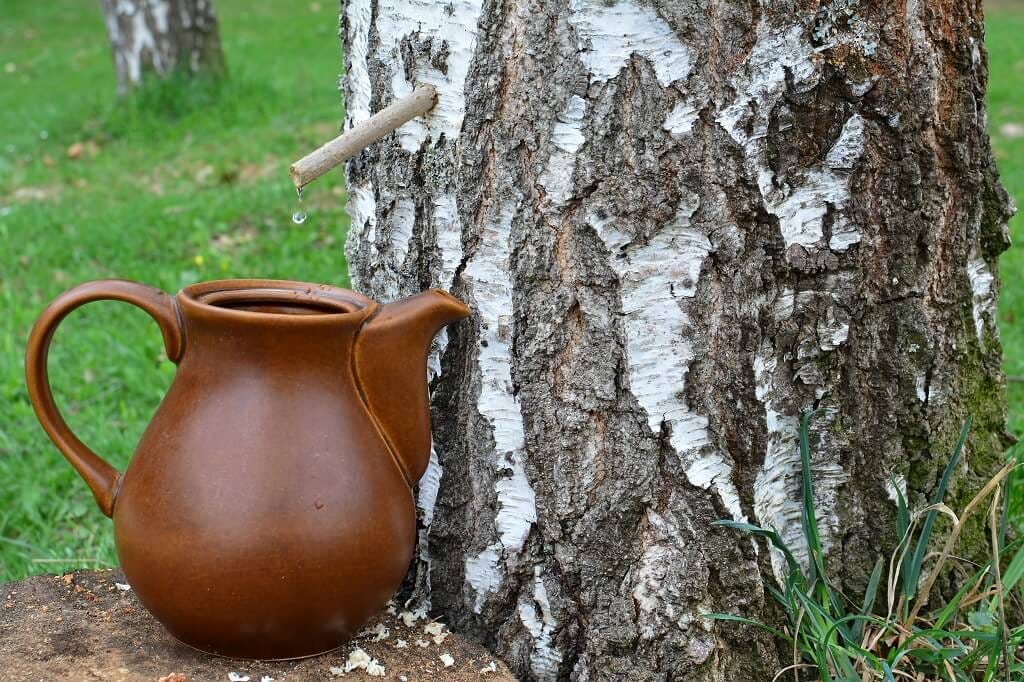
The first signs of spring were given a name by the Slavs derived from the name of the birch tree, or rather, the first month of spring was given this name: berzьńь. It may seem rather strange why the birch tree was used as a starting point in this case, but in Part I of this work [Part I of Kultura ludowa Słowian, not this translation, TN], on page 13, we read: “Throughout Russia, as well as in some parts of Poland, the Czech Republic, Yugoslavia and Bulgaria, birch sap and (less commonly) maple sap are used. By cutting the bark of these trees in early spring... , sap is extracted and consumed raw or used in various dishes.” The fact that this is a phenomenon that is very important to peasants and characterises the first weeks of spring in their eyes is best attested to by A. Osipowicz, according to whom the Masurians of Augustów in early spring (in other words, the time “when oskoła [birch sap] comes out of the trees”) directly called it oskoła. Moreover, M. Milićević found a manuscript in one of the Serbian monasteries in which the fourth month was simply referred to as brьzosokь (i.e. brьzo-sokь, where the first part of the compound undoubtedly derives from the word berza ‘birch’, and the second part certainly means sap in this case). It is also worth noting that when one of my students wrote down all the old local names of the months, given to him in 1930 by an 81-year-old Rusyn from the village of Skniłów (Złoczów County) and, not finding “brzezień” among them, asked the old man whether he knew the word ‘berezeń’, he was immediately answered: “Berezeń — it’s like bereza puskaje sik [birch lets sap, TN]; there was a name like that”. Let us add that in Belarus, in the village of Berszty (Grodno district), the old name of a month sakavik (whose meaning, however, was not given) is used; further, in the villages of Prokopowicze (same district) and Jatwieź (Baranowicze district), sakavèc ‘4th month’ was encountered, and in the village of Dworce (Prużana district), sóčeń ‘3rd month’; all these terms are obviously derived from sap ‘oskoła’. Also among the Lithuanians, who are neighbours of the Belarusians, the 4th month is called sultekis (literally ‘sap flowing’), and among the Latvians sullu-maness (sap month). The name, taken from oskoła, also exists among the Estonians; finally, among the Votes, the fourth month is called ‘the month of birches’, because they also collect sap from birches during this month.
Much more important than the sap flow in birch trees, a phenomenon accompanying spring, is the growth of grass for peasants, as it allows them to drive their cattle out to fresh pasture. The importance of the growth of grass in spring in the lives of cattle-breeding peoples is demonstrated by the fact that they sometimes consider it to be the beginning of the season; we see this, for example, in some areas of Serbo-Croatia, and in the past (when the hay economy among the Slavs was at the stage of development it is today in the remote corners of Russia, and fresh fodder for cattle was awaited in the villages with real anxiety or longing), it could probably be seen in other parts of Slavic territory, if not throughout its entire area. The Slavic name for the month travьńь*8 , used for the spring months, is perhaps the most easily explained of all in terms of its origin. It is still used today by Bulgarian, Serbian, Croatian, Slovenian and other peasant communities, while non-Slavic equivalents can be found both in Europe and in northern Asia.
Even more widespread among the Slavs than the previous one, although less popular among peasants, is the name kwiětьńь9 [in Polish: kwiecień, April, TN], referring to spring flowers, which appear in increasing numbers from March onwards. Similar terms are also used by the Germans, Dutch, etc., and also by the Latvians (Latvian zeedi-maness — 6th month; ‘zeeds’ meaning flower). Among the old Slavic names, we could also mention a few derived from the word suchь ‘dry’ and denoting the third month, as well as the name izokь, derived by etymologists from the name of the locust of the same sound.
Slavic calendar
Observing the variations in the meanings of individual month names, we can easily see that some of them were caused by climatic differences between southern and northern Slavic regions. With the exception of the name studenь (or studьńь), which is rare in the north (and probably came from the south), and grudьńь, which has a strangely divergent meaning, I know of only one case where the same name definitely means different months in the south than in the north, contrary to climatic differences; however, I know of several cases where this is in accordance with them. Thus, travьńь is the 6th or 5th month in the north, and the 5th or 4th in the south (although even in the south, grasses often fail in the 4th month, hence its Bulgarian name lьźitrev, lьźitreva); červьńь for the northern Slavs denotes the 7th or 6th month, for the southern Slavs — the 6th or 5th; lipьńь for the northern Slavs — the 7th, for the southern Slavs — the 6th; finally, sьrpьńь for the former — the 8th, for the latter — the 7th. It is striking that this shift in meaning, occurring between the north and south of the Slavic world, concerns a series of three names, neighbouring each other in order, and a fourth (travьńь), which either neighbours them or is separated from them by only one name (květьńь). Most likely, therefore, the changes in the original meaning of the names took place here within the South Slavic (or perhaps North Slavic) series, not separately for each name, but in one connection or another.
Based on many different clues, some of which are included in the above overview, but some of which are so minor or require such detailed consideration that I must omit them here due to lack of space, it would be possible to reconstruct the former order of the month names known to us as follows. The beginning of the year was most likely marked by the month of berzьņь, falling “somewhere between the 3rd and 4th month of today’s calendar and referring to the sap flow in birch trees; it was followed by květьņь and travьņьs, corresponding to today’s 4th—6 months of today’s calendar; these were certainly followed by červьńь, which may have been called “izok” in certain areas of Slavic culture for a very long time, followed by lipьńь and then sьrpьńь or zarevь and versьńь or rujьńь. Whether the names pazdernikь and listopadь meant two consecutive moons from the beginning of their existence, or whether they originally constituted a similar pair of alternative terms such as versьńь and rujьńь, is difficult to say without detailed study. The same applies to the mutual relationship between the names grudьńь and studenь. The year ended with prosinьcь and sěčьnь.
If we were to reject both pazdernikь and studenь as possibly synonymous with the names listopadь and grudьńь, we would end up with 12 different names for the months; however, if we were to reject only one of them, there would obviously be 13 such names left. Naturally, the above reconstruction, as somewhat ideal, applies at best only to some unknown parts of the former Slavic world, and by no means to the whole. In addition to the names that have survived in the mouths of the people and in written monuments, there may have been, and certainly were, other more or less local names that our reconstruction does not take into account.
Translation by Witia
1This name is known in the following languages: Serbo-Croatian, Polish, Ukrn. and Old Wilno dialect; everywhere it refers to the 10th month.
2This is also how the Lithuanians understood it, creating their name for the 10th month based on this model: spalinis v. spalu menu (cf. Lithuanian spalis ‘claws’).
3Compare also Rus. listoddr (listodór), an autumn cold north-easterly wind blowing in early September and stripping the trees bare.
4In Bulgarian — 10th or 11th month, in Serbian-Croatian — 10th month, in Slovenian — 10th or 11th month, in Czech — 11th month, in Polish — 11th month, in Ukrn., Błrs. and Old Wilno dialect — 11th month.
5This name is known in the following languages: Bulgarian (1st month), Serbo-Croatian (11th or 12th month), Ukrn (12th month), Old Wallachian (12th month).
6In Bulgarian — 12th month, in Serbian-Croatian — 12th or 1st month, in Slovenian — 1st month, in Czech — 12th month, in Old Polish (Prosień) — 12th month, in Ukrn. — 12th or 1st month, in Old Wallachian — 1st month.
7Bulgarian (sěčen, sěčko) — 1st or 2nd month; in Serbian-Croatian 1st month (and sjeć — 2nd month) in Slovenian — 1st month; in Polish (in a derailed form: styczeńj—- 1st month; in Młrs. — 1st or 2nd m; in Old Church Slavonic — 1st m. Let us add that the Moravian-Slovak term sečen ‘7th or 8th m’ or ‘the month in which grass is cut (i.e. mowing should not be used here, as it clearly refers to haymaking.
8In Bulgarian — 5th month; in Serbian-Croatian — 4th or 5th month; in Slovenian — 3rd, 4th or 5th month; in Czech — 5th or 6th month; in Slovak — 6th month; in Ukrn. 5th or 6th month; in Old Wilno dialect. — 5th month.
9In Bulgarian — 4th or 5th m.; in Serbian-Croatian — j. w.; in Slovenian — 5th m.; in Czech — j. w.; in Slovak — j. w.; in Polish — 4th m.; in Ukrn.—j. w.; in Old Wilno dialect. — 4th or 5th m.