

In this episode summary of Spiritual Culture of the Slavs, pages 172 to 230, chapter “Medicine”:
- how Slavs saw diseases
- how Slavs treated disease
- pan-Slavic herbs
S1E11 It’s not Slavic to be a Karen
Transcript below
Sława, everyone.
Sława Bogom and welcome in the 4th episode of the 3rd season of Searching for the Slavic Soul.
If you listen for the first time: in the 3rd season of Searching for the Slavic Soul I am summarising the 2 volumes of Kultura Duchowa, so Spiritual Culture, of the Slavs, obviously, written by Polish ethnographer Kazimierz Moszyński. And because it’s a summary of a publication, everything I say today is what Moszyński wrote in his Kultura Duchowa, and if I add some comments from myself, I will make it very clear that it’s me saying it, not Moszyński.
Also, Moszyński studied and recorded the spiritual culture of pre-industrial Slavs at the beginning of the XX century, so if I say Slavs this or that, these are the Slavs I mean.
Today I summarise pages 172 to 230, which are chapter 6 of Spiritual Culture, which is titled “Medycyna”, which means “Medicine” – as the medicine that one has to study to become a doctor, not the medicine that one takes to get better.
Medicine vs magic
As Moszyński notes in this chapter, there was a very faint difference between pre-industrial Slavic medicine and pre-industrial Slavic magic and in many cases it was pretty much not possible to say, whether what was done in order to cure a disease, was medicine or magic. There is a special chapter in Kultura Duchowa dedicated to magic, so it will be discussed in depth in later episodes of this season, and here, following Moszyński, I am going to focus on the most medicine-like attempts to treat the sick and the suffering.
Medicine – the deterrent
One thing that is pretty much obvious while reading this chapter is that it was nothing nice to be sick among the Slavs. Which, let me add from myself, seems to be a pattern in folk medicine, one that aims, as it is explained by anthropologists and evolutionary psychologists, who developed costly signalling theory, and basing on this theory they explain that the aim of the patterns is elimination or reduction of number of freeloaders. Basically, if you’re sick, you can’t work or contribute and people have to give you free and valuable stuff, like food, shelter and assistance, so treating you is costly for your community and therefore can be potentially abused by lazy people. So, in order to discourage freeloaders from pretending to be sick or exaggerating their symptoms, the treatment of majority of conditions in pre-industrial times, involved painful, extremely unpleasant and often humiliating procedures. And that was done to make sure that only sick people, only the people who really need it, get free stuff. Slavic medicine is no different, so a fair warning, before we dig dipper in the chapter – if you’re sensitive to brutal or disgusting stuff, reconsider listening to this episode.
Some etymology (sorry, I can’t help myself...)
Moszyński, as majority of people in his times, is not sensitive and in order to explain the internal logic of Slavic medicine, starts with the Slavic theories of how a disease develops… Oh, no, he actually starts with etymology and from there gets to how the diseases develop. The etymology bit I think is not as important to followers of Slavic Native Faith, other than, maybe, mentioning that a lot of names of various diseases are actually pan-Slavic. That’s not surprising with regards to names of various skin diseases, since, all sorts of rashes and eczemas existed and presented itself in exactly the same way since humanity developed as a species, so it’s not surprising that names of skin lesions, such as *pr̥chъ, *pryščь, *korsta or *bordavъka were used well before Slavs developed distinctive and separate languages.
There is also a trend in the Slavic names of diseases, that tells us a little bit about the way the Slavs saw diseases: they were really scared of them. So scared that they actually developed linguistic taboo, to not to name properly the more serious disease, because the Slavs believed, that using the proper name is like calling in the thing and inviting it to stay. So Slavs would call such diseases nepomènȋk or nepomènuše, – which means ‘one which name can’t be mentioned’. Or they would call them mothers, aunts, friends, sisters or visitors, to, kind of appease the disease and get the disease to be kind and go away. For example, in Serbia the plague was called kúma, which means ‘a female friend’ or tetka, so ‘an aunt’. Same names in Ruś were used to name diseases with high fever. Such disease in Belarus were called gòstia or gòstiuŝka, which means ‘a female visitor’, and the latter form, gòstiuŝka, is a diminutive form giving the name a meaning of something little, benign and nice. In Bulgaria insomnia was called gòrska màjka, which means a mountain mother. Till this day rheumatism in Polish is galled gościec, which means ‘a guest’. In Belarus any sort of paralysis or convulsions were called rodimec, which originally meant ‘nice’ or ‘lovely’. However, with regards to this name Moszyński mentions that as he was writing Kultura Duchowa a semantic shift was already taking place, namely the rodimec name started to be associated with the unpleasant disease, and started losing the nice/lovely connotations. So in his research Moszyński noted that there was a new name developing: icho, which means ‘belonging to them’.
The other category of names of diseases were, kind of, pointing towards the malevolence of the disease, but trying to soften the blow, so to speak, by using a diminutive form, such as lichodèjka, so ‘a nice or lovely female entity that brings a demon’.
Malevolent etiology
And the reason why Slavs were so scared of diseases – other than the obvious reason, of course, which is that back then people were still sane and actually did not want to be sick, which is, obviously, my comment not Moszyński. But the less obvious reason was that Slavs believed that diseases are a result of some demonic or supernatural activity, like a curse for example, with an underlying assumption that it is some sort of punishment, some sort of curse, bad luck or a result of malevolent activity, against which a Slav had to protect him or herself and the whole community.
Slavs believed that many childhood diseases were brought on by the Moon or stars, such as the constellation of Pleiades, which for the life of me I don’t know how to pronounce. In the case of the constellation, from the 1st episode you hopefully remember, that some Slavs perceived this constellation as a group of hens and they believed, that when these hens are visible on the night sky, they ruffle their feathers and all the diseases fell from their feathers on the Earth and this is how diseases develop in children and, sometimes in animals too. The Eastern Slavs believed that solar eclipse brings particularly bad diseases, so they hid during eclipses. Many disease could be caused by wind, which – let me add from myself – is reflected in Polish language to this day in an idiom “przewiało mnie”, so ‘wind blew through me’ which is used to say that someone caught cold, or cystitis or sometimes even kidney stones.
Fear
As I already mentioned in the 3rd episode of the 2nd season (to which I will link up in the notes to this episode) many diseases were caused by przestrach, so a sudden fear, of which I will not elaborate more here, but will send you to the episode, where przestrach was talked about at length.
Earth
Diseases could be also caused by water and by the Earth herself. Moszyński gives an example of a farmer from Nizhny Novgorod, who told him, that if one fells on the ground, sustains injuries and gets unwell after that, that is because the Mother-Earth is angry that this someone hurt her, so she is hurting this person back as a punishment. Other than injuries, the Earth could also cause all sorts of other diseases, which were treated by apologising to Mother-Earth for hurting her and giving her some groats as an apology gift.
Worms
An interesting cause of diseases were worms, which Slavs, particularly in Poland, believed every one had. This worms are necessary for us to live, so if we didn’t have them we would die, but sometimes there is too many worms or they move in the wrong way, and this is what’s causing diseases. These worms could be causing all sorts of symptoms, from pain around the heart, through difficulties in breathing to blindness or even tooth ache. In other parts of Slavdom, the diseases were not caused by worms but by other animals, like frogs, lizards, snakes or tortoises, but the difference between the worms and frogs or lizards was that the frog or a lizard entered the body to cause the disease, while worms were in the body all the time, and only some of the time caused diseases. However, it needs to be mentioned, that it was not unusual for frogs, lizards or tortoises to enter the body when they were still small and only cause the disease after growing some more and becoming stronger.
By the way, I add from myself, the worm theory of disease was preserved in Polish language in a saying “zalewać robaka”, which means ‘to flood a worm”, which is used to explain therapeutical effects of drinking alcohol. You don’t drink to get drunk. You drink to flood the worm that’s bothering you. So you drink “na zdrowie”, which literally means ‘for health’, but is used in Polish as “cheers” or “bottoms up” in English.
Cats and wolves
But, back to Moszyński. As far as animals, cats could also be causing diseases, however not directly, but indirectly. For example in Belarus it was believed that tuberculosis was caused by accidentally swallowing a cat’s hair. Wolves could also cause diseases, which, again, this one is my comment, is reflected in a Polish idiom “złapać wilka”, so ‘to catch a wolf’, which means to contract water infection.
Crayfish
From a linguistic point of view there is a very special type of animal that could cause a serious disease, namely crayfish. It was actually quite widely spread belief that crayfish could enter the body of a human and start eating it. Such disease was called rak, which is a pan-Slavic name of both the animal crayfish and the disease cancer. BTW, such view of cancer – the disease – seems to be pan-European, not only pan-Slavic, since even the English name “cancer” comes from Latin and Greek names of the crayfish or a crab. But that’s my comment, not Moszyński.
Demons
And, obviously, a lot of diseases were caused by demons. In this chapter Moszyński mentions a few, but he states that most of the disease-causing demonic influence will be discussed in the later chapter on demonology, so we will get there too. But, there is an interesting mention, namely postrzał, which means ‘a wound or injury inflicted by a projectile’, which is the name of a sudden lower back pain that Slavs believed was caused by a demon shooting or hitting the person with something. Moszyński suggest such concept could not be uniquely Slavic, since, apparently, there is an Anglo-Saxon concept of ylfa-gescot, which means ‘elf-shot’ and is a name of a sudden, stabbing pain, which Anglo-Saxons believed was caused by invisible arrows or darts shot by elves.
Recovery or death
But, back to Slavs. If you look at the Slavic model of disease, the way of treating the disease become quite understandable. Because, if you have something in you that’s been put there by some demon, a curse, a natural element like wind or water, or it’s just excess of misbehaving worms or frogs or lizards, it’s only natural that you want this something out of you. And in the attempts of getting this something out of people Slavs really went for it, in terms of creativity and persistence.
The basic approach to a disease was to never give up. It was an approach taken by both the patient and the people who were treating the patient. If one approach did not work, then another one was tried, and then another one, until either recovery or death from the disease happened. And it really was a kind of whichever comes first type of thing. To the point that Moszyński even wonders whether some of the approaches to most serious and most chronic diseases were not an attempt to shorten the suffering of the sick person. However neither Moszyński nor anyone else found any evidence of an actual explicitly stated euthanasia, because all of the treatments served to the patient were presented and talked about as cures, even if they involved, say, giving the patient poison or beating the patient severely, or even leaving the patient overnight in a forest with no protection, no weapon and no shelter.
The exception of mental disease
However, there was a very special type of disease that did not have to be treated until cure or death, and that was mental disease, in which Slavs included both intellectual disability and what we know today as psychiatric diseases. Moszyński does not write a lot about approaches to such diseases. He mentions that there were some attempts to cure them, but generally, if they were chronic or congenital issues, the Slavs actually treated mentally unwell people with a certain level of respect or even reverence. I am going to add from myself, that this aspect of Slavic culture is discussed in depth by a Bulgarian ethnographer Katja Michajłowa in a book titled – in Polish “Dziad wędrowny w kulturze ludowej Słowian”, which means wandering beggar in folk culture of the Slavs. I am going to shamelessly brag here, that last year, after years of hunting it down, I finally managed to get hold of this book and it is awesome! It seems it’s only published in Polish and Bulgarian, not in English, but if you read in Polish or Bulgarian, do try to get a copy, because it’s a very important book for any follower of Slavic Native Faith. And what’s relevant in this book to what Moszyński is writing, is that Michajłowa’s book makes it clear that among the Slavs mentally unwell or disabled people were seen as remaining more in touch with the supernatural or the divine, likely because such people were perceived as less in touch with the reality. Obviously, no one listen to them when the question was related to the reality, to for example how to run a household or a farm, but they were perceived as having supernatural powers and more keen insight into the realm of the ancestors or into the future for example. So, they were seen as sort of healers or fortune-tellers.
Moszyński describes a case like that. It was a 30 years old woman, who lived in a village of Podovećje in the Skopyn district. It was not clear if she was intellectually disabled or suffered from some neurological or psychiatric disease, but she could barely speak and could not look after herself. She was kept in a separate, purpose build hut. She had to be chained to the floor, and the chain was attached to her body by a belt in her waist. She did not wear clothes and, as everyone back then, did not wash, or was not washed often, so her skin was dark from dirt, as well as from the smudging that was back then used as a cleaning method. And she was a very popular healer and fortune teller. People came to visit her from all over the district.
To you such housing conditions are torture, but in the pre-industrial times it was literally the highest level of care. Someone took time to build her a hut – a hut only for her, she did not have to share it with anyone else, which was unusual luxury back then. She did not work in the field, did not produce anything, but was fed and sheltered, for decades. They could have let her wander off and die from exposure or wild animals, but instead someone took time to make a belt for her – from material that could have been used somewhere else and even pay for a chain – a really expensive, hand made item to keep her safe. That’s care. And also, let me add from myself, a very good lesson for any morons who think it is appropriate to judge the past by the standards of the present. It is not. It never is. Especially now, in the West, when we live in luxuries unimaginable for 99.9999% of the rest of the humanity who even lived.
So, long term mentally disabled people were not treated till cure or death. But only the long term disabled or unwell. Short term there were actually attempts to treat even psychological or mental problems. Moszyński describes it giving an example from Montenegro, where there was a case of a famous warrior who lost his mind after losing his leadership position in the tribal military. And he lost this position to another warrior. So, in order to treat his lost mind, he was hanged by his legs, head down, thorns were stuck in his fingers and then he was smudged with a smoke from burning chicken faeces and asked for the names of the demons that possessed him, so these demons can be called out to leave his body.
First line treatment
But in milder cases of disease, such approach was not used straight away. Slavs started with the most basic, as we would call them, first line approaches. One of such first line approach was application of compresses with vinegar or mustard seeds to either the part of the body affected by a disease, or to the whole body, if the disease was believed to be internal. The thinking behind it was that if the disease is sitting in the body and we make the body uncomfortable, so the disease will not want to sit in the body any more and will come out. After compresses with vinegar or mustard seeds the skin will be irritated and likely will develop some sores, which was interpreted as a sign of the disease leaving the body. Because, you know, if the disease is leaving the body through the skin it has to break the skin, so if the skin is broken, then it means the the disease has left. Such vinegar or mustard seed compresses were believed to be particularity effective against diseases caused by a curse.
Another first line approach was inducing vomiting in the patient, so the patient can throw up and out the demon, curse, worms, frogs or whatever was sitting inside him or her. The vomiting was induced by administering to the patient substances that were either just foul tasting or substances that were simply foul, like manure. The alternative to vomiting was diarrhoea which was induced with various natural laxatives. Patients that were lucky enough to be assessed as not in need of consumption of manure, were smudged with burning, dried manure or, alternatively, they were rolled in or covered in manure.
The other option was borderline-magical usage of prickly plants, such as thistle or stinging nettle, which was used for smudging, whipping or to make an infusion for the patient to drink. Moszyński stresses that the primary feature that Slavs looked at was not what the plant does, but how the plant look. If it was prickly then it was believed to be sufficient to make the disease uncomfortable enough to leave the body. And, since the prickliness was the point, a meat alternative to prickly plants was a hedgehog, which was used whole to make a broth, which in some part of Slavdom was considered the best treatment for all sorts of internal diseases. The hedghog’s skin was also believed be great protection from diseases and therefore was used as a form of prophylaxis.
Moszyński, as I keep repeating, is a very honest scholar with great integrity, so he does admit that many of the prickly plants could have some beneficial medicinal effect, so, even though they were chosen basing on their looks, they still should be considered a sort of medicine, not magic. Same goes for the hedgehog. It might not be a big animal, nevertheless, a whole hedgehog broth, like any broth, is very nutritious therefore, in times where malnourishment was a common underlying cause of many diseases, consuming hedgehog broth might have legitimately been helping patients to get better.
Oh, I forgot, since ants are kind of prickly, anthills were also used in various treatments, in preparation such as infusion made out of anthill to take internally, or the patient or the patient’s body parts was given a bath, after an anthill was put into the bathtub or a bucket.
Second line treatments
Slavs came up with a lot of ways of making the disease leave the body. Various forms of squeezing, rubbing or massaging out were used, as well as beating, burning or cutting. Again, Moszyński notes that the squeezing, rubbing or massaging could be actually beneficial in some joint or muscle diseases, like modern physiotherapy is. Similarly, burning of a wound or cutting out an infection could be helpful too, hence such methods are qualified as legitimate treatments.
Another way of getting the disease to leave the body was to try to convince her – the disease – to leave the body, which was done by zamawianie, so a form of magic or oral form of literature – depending on how you look at it. Moszyński acknowledges it and mentions it’ll be discussed later and in this chapter only signals that zamawianie was a part of Slavic medicine.
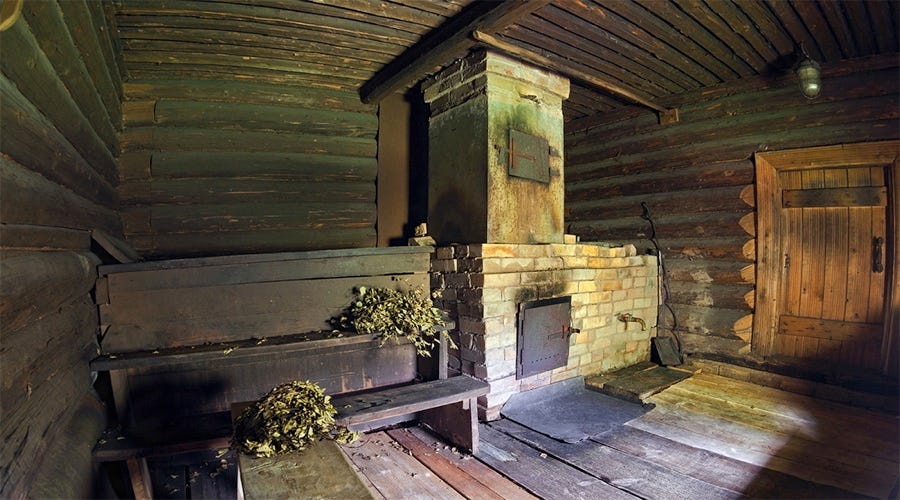
Yet another way to get the disease out of the body was to suck it out or drain it out. Hence blood letting was sometimes used, as well as sucking out the disease from wounds – which as Moszyński correctly notes, in some cases of contaminated wounds, might have been beneficial. Slavs also widely used cupping, although they did not use many small glass cups as it is done nowadays, but they used one large clay pot or an ox horn. The same of horn that was used to drink. Also sauna, both dry and wet, was used in Slavic medicine, based on 2 principle: sweating the disease out and making the disease uncomfortable. To increase the discomfort of the disease very often, if not always, while in sauna whisks or brooms made of stinging nettle or willow branches were used to whip the body. Moszyński notes that such sauna procedures were also used as a disease prevention and this element of Slavic medicine is very much alive in modern time, in pretty much all Slavdom.
And, also, what’s important to notice, is that the 1st and 2nd line of treatments could be combined. So, for example, as a way of treating a disease, one could be, rolled in manure and then beaten, which, as you know from the 1st season of Searching for the Slavic Soul, was a recognised way of dealing with demonic possession in children.
Slavic homeopathy
A whole another branch of Slavic medicine is, we could call it, homeopathic approach. The methods described so far were designed with the principle of getting the disease to leave the body, but the as I called it homeopathic, and as Moszyński called, sympathetic approach was based on a principle that similar things are more likely to interact with each other. Basing on this principle, Slavs used yellow flowering plants to treat jaundice – a condition when the human is turning yellow, typically, but not exclusively, because of a dysfunction of the liver. Or they would use plants which leaves are heart-shaped to treat heart diseases. Of they would use the kidney-shaped leaves of hazelwort to treat kidney diseases. Or use stuff that’s red to treat skin lesions that are red – you get the idea. Moszyński stresses that it also could have work, since, for example, some plant with yellow flowers, might actually be beneficial in liver issues, so if the right yellow flowers were used, it would have actually been an effective medicine.
There is a bit of a horror aspect to the Slavic homeopathy, since as you’ve heard in the 11th episode of the 1st season of this podcast, Slavs did associate black cats with some demons. So, in some cases, on the sympathetic or homeopathic principle, a black cat was used to treat a disease that was believed to be caused by demons. Most frequently it was blood of a black cat, but in Belarus for example, a dried and powdered placenta of a black cat was used as such medicine.
Slavic herbs
Moszyński spends a lot of time on Slavic herbal medicine, but I will not be getting into it, since the way the herbs work is universal, well researched and you can look it up yourself. However I am going to list the pan-Slavic names of herbs, following Moszyński’s assumption, that these herbs were known to the original, pagan Slavs and are perhaps the oldest part of Slavic medicinal tradition:
Malva or mallow as well as marsh mallow which throughout the Slavdom, at the time of Moszyński’s research was nearly universally called ślaz, slĕzь, slizь or similar, all these names meaning slime, slimy or having to do with slime, sometimes with a prefix, as in Polish ślaz = malva, prawoślaz, which means the right or the correct slime = marsh mallow
Aniseed, which, again, at the time of Moszyński’s research was nearly universally called biedrzyniec, biedrzeniec, бе́дренец and similar. Moszyński does not give the meaning of this name, but I did check and biedrzeniec appears to mean ‘one that is spotty’ or ‘one that has spots’.
Lemon thyme which was typically called macierzanka, macierza duszka, matere duška or similar, which means something along the line of uterus or the source of life with the duszka/duška qualifier meaning ‘of a lovely smell’
Mint, which in Slavic languages is pretty much universally called mięta or męta. Moszyński states that this name is of Latin origin, however I looked through my dictionaries and it appears that *męta is actually a proto-Slavic word, meaning mint, so it was used by all our Slavic ancestors.
Common mullein, with a South and West Slavic name dziewanna, divizna or similar, which literally means ‘a female entity that induces awe’
I might just add from myself here: dziewanna is not and never has been a Slavic goddess. It’s fakelore. Don’t fall for that.
And back to herbs:
Valeriana, which, as states Moszyński, used to be called by Slavs odòljen, odòljan, which comes from proto-Slavic *odolě̀ti, which means to overcome or to defeat, so valeriana in Slavic understanding in ‘one that allows to overcome or to defeat something’
Coltsfoot, which has 2 names: either podbĕlь which means ‘one that has white under’ (it’s because the underneath of the leaves of coltsfoot is white) or mat i màčecha, which means mother and stepmother. Moszyński does not give and explanation for the latter name, however, after looking into it, it appears that this name is also related to the leaves of this plant, because the top of the leaves is smooth, cold and shiny – like a stepmother, and the underneath is soft, fuzzy and warm – like a mother.
Burdock with its nearly pan-Slavic name łopian or łopuch, which comes form proto-Slavic *lopěnъ, meaning ‘a plant with large leaves’
Common wormwood, called pretty much universally across Slavdom piołun, połyn or similar. Moszyński only states that it’s a pan-Slavic name, but I looked up the etymology and it comes from proto-Slavic *pelunь, meaning ‘a bitter, burning plant’
Tansy, known among Western Slavs as wrotycz or wratič. Again, Moszyński does not give etymology, but I checked and it appears that the name originates from proto-Slavic *vortiti, which means ‘return or turn round’, which makes sense, since tansy was used as a dewormer, so it was used to, in a sense, get the worms to return or turn around from moving in the wrong direction in the body.
Horse-heal, which was called oman, so ‘one that enchants’.
The diagnosis problem
So, these are all pan-Slavic or nearly pan-Slavic herbs. If you look into the medicinal usage of these herbs, you will realise that they legitimately can be used as medicine. Which is also Moszyński’s conclusion and what he says, which I find very insightful, is that it appears, that in Slavic medicine the problem wasn’t actually the treatment, but the problem was the diagnosis. If the diagnosis was known: like in case of wounds, broken bones or, say, head injury, Slavic medicine was really effective. Slavs were really good at wound management, at repositioning and healing fractures and there is plenty of evidence, both from Moszyński’s research and also archaeological evidence, that Slavs knew how to perform trepanning, so burring holes in the scull to relieve intracranial pressure. They hit a wall though with internal diseases, mostly because their concept of the aetiology of these diseases was misguided. Which is not surprising, since, before the modern science developed, no-one really knew what causes jaundice, cough or kidney infections.
And that is all as far as the summary of pages 172 to 230 go. Hopefully, you’ll find it helpful or at least interesting. The chapter I summarised today is also the last chapter in the 1st section of Kultura Duchowa, which deals with Slavic knowledge, and the next section, we will start summarising next month, is about the religious life of the Slavs.
Witia’s conclusion
Before we end, I would like to share with you my conclusions, to make sure that I highlight the most important in my opinion lesson from the chapter on Slavic medicine, namely that Slavs did not want to be ill. They did not want to have any diseases and if they did get a disease, they went to great lengths to get rid of it.
Over the last decade or so I have noticed that a lot of modern Slavic Pagans, or rather, as they call themselves, identifying as Slavic Pagans, that they also identify as having various diseases. And they seem to be happy with this diseases, which from the Slavic Pagan point of view is simply wrong. No Slav ever become his or her disease. No Slav ever was happy to have a disease, celebrated his or her disease or identified him or herself as the disease. In the Slavic way of thinking a disease is something that enters the body and needs to be purged from the body, by all means necessary.
The exception to it was chronic or congenital mental disease or intellectual disability, which at initial stages was attempted to be purged out of the body, but if it did not work, it was left there to be. However, living with such a disease in your body did not mean you did not have to contribute. Like this woman from Podovećje, a mentally unwell Slav still had to contribute, be it by taking on healing or fortune telling. There was no freeloaders among the Slavs and no one was allowed to stay on disability forever. No one also thought that the system was unfair, biased or privileged in any way. The bad things that happened to you were either a result of your Dola, or a result of others’ Dola, or a result of your inability to protect yourself from demons, curses, cats, wolves, lizards or winds, a result of you disrespecting Mother-Earth or just an imbalance in the number or in the movements of your internal worms. You just dealt with it, and if you were lucky, your family and community supported you in dealing with it.
So, my aspiring Rodnovers. Stop identifying with your disease, get better and start contributing. Go to sauna. Drink some pan-Slavic *męta or *lopěnъ. And if you fear is that you can’t do much to contribute, drink some valeriana, which will allow you to defeat this fear. You can do it. It’s in your blood. Your ancestors survived being rolled in manure, fed with manure, smudged in manure and being beaten up while lying on manure. With their blood in your veins, you can survive and overcome anything that’s in front of you.
And that’s all I had to say for today. Thank you for listening and until the next episode, which will come out in the moon of linden, when we will talk about prayers, sacrifices and rituals. And until then: Sława


