

Rodnovery 101: Altars
Basic information on altars in Slavic Native Faith

The presence of altars in Slavic paganism is not clearly attested in historical sources. While chronicles and accounts frequently describe pre-Christian Slavs offering sacrifices to their Gods—for favourable weather, success in battle, or to solemnize agreements—the texts rarely specify dedicated altar structures.
Sacrificial methods varied widely. One enduring practice involved drowning animals (such as horses or chickens) in bodies of water, a custom remembered into relatively modern times. Some sources hint at more extreme rites: Pseudo-Caesarius, in his Dialogues, claims Slavs dashed unweaned infants against rocks, though it remains uncertain whether the rock functioned as an improvised altar or even if the act was framed as a deliberate offering rather than infanticide. Corroborating references appear in works like Leo the Deacon and the Primary Chronicle, which confirm child sacrifice among some Slavic groups, but without detailing altars.
Other accounts point to natural features serving as focal points for worship. Constantine Porphyrogenitus describes Ruś merchants performing sacrifices beneath or near a great oak tree on an island, where they stuck arrows in a circle around the site, alongside offerings of bread, meat and live birds. Whether these arrows marked out a sacred boundary resembling an altar or constituted part of the sacrifice itself is ambiguous.
Battlefield contexts produced even more ad hoc arrangements. Thietmar of Merseburg records the Lutici conducting a human sacrifice to their Gods before the walls of a newly conquered city—likely a temporary rite improvised in the heat of war, with any “altar” being makeshift at best.
A later reference comes from a dramatic letter by the Archbishop of Magdeburg (circa 1108), which accuses the Obodrites of slaughtering Christians on altars of pagan idols. However, the text employs highly rhetorical, inflammatory language typical of pleas for military aid against pagan Slavs. Exaggeration or metaphor (portraying pagan violence as ritualistic) is quite possible, so it cannot be taken as reliable evidence of formal altars.
Archaeological evidence for permanent altars or temple structures remains limited, largely because Slavic sacred sites often used perishable wood, and many were destroyed during Christianization. Surviving finds—such as idol statues, sacred precincts with sacrificial pits, or wooden shrines (like those at Peryn near Novgorod or sites on Rügen)—suggest ritual spaces centred on images of Gods, fire altars (крада), and offerings, but not always a stone or elevated altar in the classical sense.
A medieval East Slavic Christian writer known as Христолюбець (”Christ-lover”), active sometime between the 11th and 14th centuries, explicitly distinguished between:
столы (”tables”) — ordinary surfaces on which pagans supposedly made their sacrifices
жертвенники / алтари / трапезы (”altars” or “holy tables”) — consecrated spaces reserved for proper Christian offerings, especially the Eucharist.
This contrast appears in anti-pagan polemical texts that condemned syncretism and sought to eradicate lingering pagan customs. It remains unclear whether the difference was purely rhetorical and theological—a way for Christian authors to denigrate pagan rites as profane and makeshift (using everyday “tables”) while elevating Orthodox worship—or whether it reflected an actual distinction in pre-Christian Slavic practice.
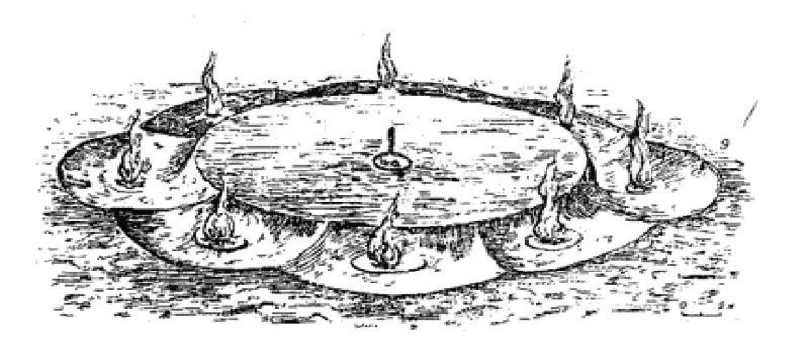
The purpose
Drawing from historical, written, and archaeological sources, pre-Christian Slavic paganism shows no strong evidence for standardized, dedicated altars as sacred structures in their own right. Sacrifices—central to worship—often occurred without any fixed altar:
Many rites involved drowning offerings in water (e.g., animals or other items) or burning them in open fires/крада.
Rituals frequently took place at natural sites: sacred groves, oaks, stones, rivers, or around idols and temporary setups (e.g., arrows in a circle, battlefield improvisations).
Western Slavic temple sites (e.g., Arkona, Radogost, Peryn near Novgorod) featured wooden shrines or enclosures with idols and possible sacrificial pits/fires, but not elevated stone or permanent altars in the classical sense.
No sources describe indoor altars or household tables as formal pagan ritual foci. Domestic hearths held importance, but structured indoor altars appear absent.
Thus, any “altar” served primarily as a practical means to facilitate sacrifice and communion with the Gods—rather than an inherently sacred object requiring elaborate construction or perpetual maintenance. Many rites succeeded perfectly without one.
Modern Rodnovery practitioners should therefore treat altars pragmatically: as functional tools for offerings, not obligatory sacred furniture. Indoor setups, lacking historical precedent in pre-Christian Slavic practice, likely stem from Christian influences or modern, overzealous reconstructions/fakelore.
In authentic spirit, prioritize the act of sacrifice—outdoors, at natural features, or simply with fire/water—over rigid structures. This keeps the focus on living connection to the Gods and ancestors, true to the flexible, nature-centred tradition.
How to start:
To keep your practice rooted in the historical spirit of pre-Christian Slavic traditions—flexible, nature-focused, and free of later Christian or neo-pagan formalities—begin this way:
If you already have a dedicated “Slavic pagan” indoor altar (especially a structured setup with statues, arranged offerings, candles in rows, etc.), dismantle it. Pre-Christian sources show no evidence of fixed, sacred indoor altars.
If you don’t have one, don’t build one. Avoid creating obligatory altar furniture as a core requirement.
Instead, choose a simple, modest indoor space for daily reverence:
A small shelf, windowsill, side table, or the area near your hearth/fireplace.
Place there only meaningful, non-ritualistic items: family photographs or heirlooms to honour ancestors, small symbols of household protectors (Domovoy tokens, rushnyky/embroidered towels, seasonal herbs or flowers).
Use this space quietly for remembrance or small offerings to ancestors and home spirits. Think of it as a place of connection, not a “pagan altar.”
For offerings to the Slavic Gods:
Go outdoors. Select a natural location that feels appropriate and accessible: a riverbank or stream (perfect for drowning or pouring), a prominent tree, a large rock, forest clearing, or a hill.
Make the sacrifice directly at that place: burn offerings in a small fire, cast them into water, bury them in the earth, or leave them respectfully on the ground or tied to a branch. No dedicated altar is needed.
How to continue
Once you have chosen one or more natural sites for regular offerings, treat them as living sacred spaces (echoing holy groves):
Return to the same place(s) consistently for sacrifices, seasonal observances, prayers, or quiet communion with the Gods and land spirits.
Maintain and care for the site as an act of reciprocity and devotion:
Regularly pick up litter and remove any human debris.
During dry periods, water nearby plants or young trees.
Plant native herbs, flowers, or shrubs that can be used in future rituals.
Keep the area clean and undisturbed, showing respect to the place itself.
This stewardship turns the site into a personal sacred relationship rather than just a backdrop. Over time, the bond deepens through repeated visits, offerings, and care—keeping your Rodnovery authentic, action-oriented, and deeply tied to the natural world rather than to constructed indoor shrines.
Further reading/listening


