


In this episode:
-> How to stop being a useless freeloader and become a Slavic hero
-> What do Russian byliny tell us about how to make decisions and how to live
-> How to worship Slavic Gods
-> When will the 3rd season of Searching for the Slavic Soul start and what it will be about
Transcript below
Hello, everybody.
Welcome in the 7th and the last episode of the 2nd Season of Searching for the Slavic Soul. Today we will continue the topic we started to explore in the last episode, namely the topic of stories which are being told by humans to explain their life, their place in the world and to explain the world itself. These stories are a part of every culture and every human who ever lived long enough to participate in any culture have been exposed to such stories.
In the last episode I argued that the stories you tell yourself are 100% incompatible with the stories told by Slavic Pagan culture. I gave some examples of stories told by Slavic Pagans, including superficially Christianised Slavic Pagans. But giving the examples I focused on showing you how incompatible with Slavic Paganism are the stories you tell yourself. Today however I want to focus on the stories that we – the Slavic Pagans – tell ourselves. And I do make the distinction between you and us very clearly and on purpose. Mostly because it is an undeniable distinction, but also to make one thing abundantly clear: Slavic Paganism is divisive. It is exclusive, as in: it excludes stuff. It discriminates - as in: it considers some groups of people more worthy than others. And, also, Slavic Paganism divides: it divides into us and them, into correct and incorrect or acceptable and not acceptable.
So, as a side note, it is a very useful rule of thumb, to consider as BS any publication or group or, as called nowadays, community, which claims to be at the same time Slavic Pagan and inclusive. There is no such a thing as an inclusive Slavic Paganism, because Slavic Paganism divides the world into, for example, family – about which any Slavic Pagan is supposed to care and which any Slavic Pagan is expected to put first. And anything that is not family – so pretty much the whole rest of the world, is something any Slavic Pagan is not supposed to put first and about which any Slavic Pagan is expected to care only if this particular element of the rest of the world affects or is otherwise pertinent to the wellbeing and the future of his or her own family.
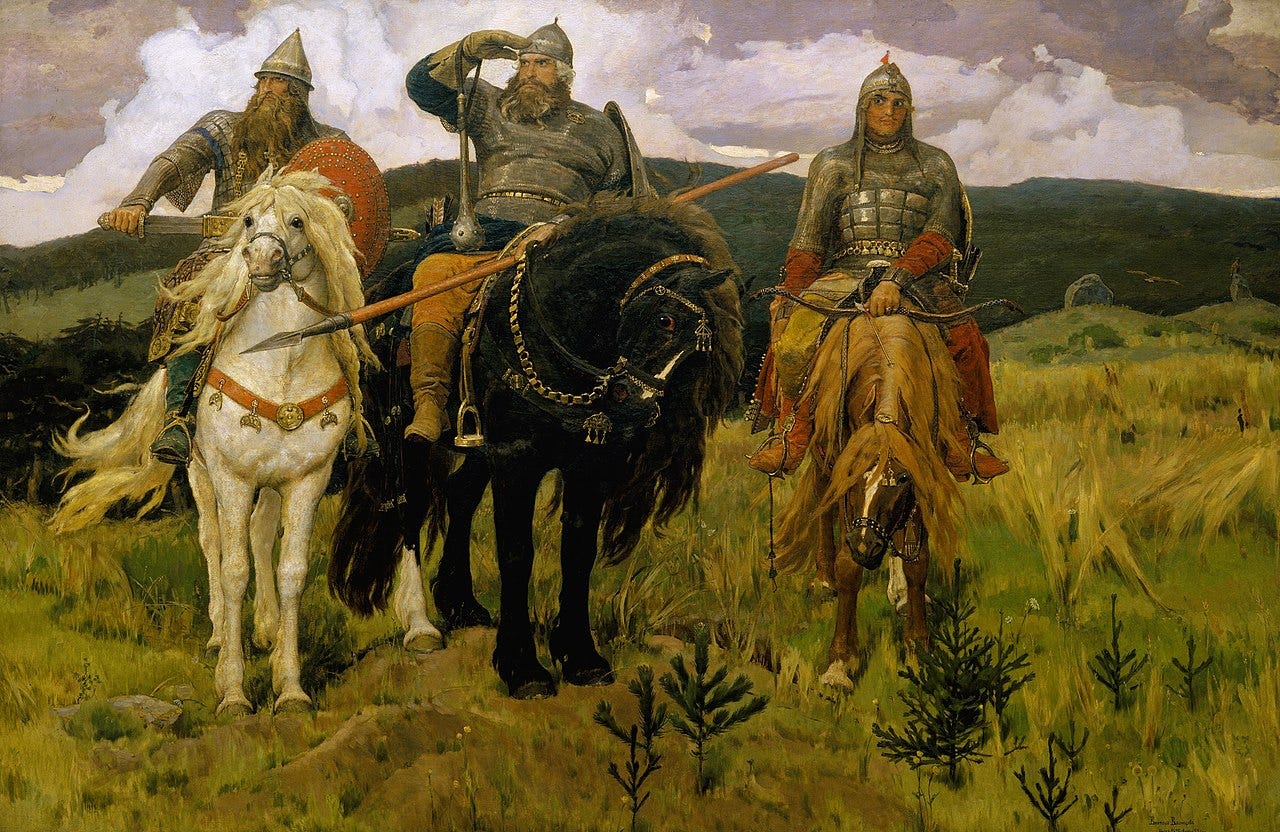
To illustrate this point, let me get back to byliny and the story of Ilja Muromiec. If you listened to the last episode, you should remember that Ilja Muromiec was involved in defending Kiev from invasion of Golden Horde of Mongols. He asked 12 other богатыри, so heroes of byliny, to help him to save Kiev, but the богатыри – among them Samson, Ilja’s godfather – they refused to help, because they had nothing to do, no relation whatsoever with Kiev and its ruler kniaź Vladimir, to whom Ilja Muromiec swore his service.
But, there is more to the story, since, as it’s told in byliny, Ilja Muromiec, despite no help from the богатыри, went on to fight the Golden Horde of Mongols. And as he was fighting with the Mongols, he got in serious trouble, because the Mongols caught him and took him to tsar Kalin. Ilja managed to escape but then he realised that his time is neigh and decided to call upon Samson, his godfather, not to help Kiev, but to help him. So Ilja shoot an arrow and told this arrow to fly to Samson. The arrow flew to Samson, went through the fabric of the tent in which Samson was resting and landed on Samson’s chest, but only made a small scratch on his skin, without actually hurting him. Samson woke up, looked at the arrow, straight away realised that his godson is in danger and without any hesitation galloped to help Ilja. And the other богатыри galloped with him and then proceeded not only to save Ilja, but to save Kiev.
So the 12 богатыри did exactly the thing they did not want to do when Ilja Muromiec asked them before. But, when Ilja Muromiec asked them for the first time, he was not in any sort of danger. He was just doing his own thing, that had zero to do with the future or wellbeing of the family. But when Ilja send his arrow, he was obviously in danger and the богатыри helped without hesitation. Because for богатыри Samson was their brother, and Ilja was a godson of Samson, so, by Ilja’s life being in danger the cause of Kiev suddenly went from the category of the rest of the world to the category of family matter.
And by the way, this point of view, that discriminates against and excludes not-family is the very reason why Slavic Paganism does not scale up above the level of a tribe. There are whole books written about failed Slavic Pagan states in early medieval ages, so I will not be elaborating on this topic today. I am just going to mention that so called Pan-Slavism and all these calls for Pagan Slavs to unite are moronic and ahistorical and you should 100% ignore them if you want to follow Slavic Native Faith.
But, if you want to follow Slavic Native Faith, you should 100% listen to stories that we – the Slavic Pagans tell and have been telling for hundreds of years. The Russian byliny are such stories – although they are, of course, not the only ones. But, still, I have neither time nor place here to present all the stories of Slavic Paganism, so I made an executive decision to refer to byliny, particularly to the Kiev cycle of byliny, because Ilia Muromiec is one of the heroes in them. Obviously, there are other heroes in byliny, but I focus on Ilia Muromiec because he suffered a serious case of failure to thrive which, in my opinion, is very relevant for aspiring modern Slavic Pagans, particularly in the West.
As the story goes, for the first 30 years of his life Ilia Muromiec could not do shit. He literally would sit in the house while his parents and his siblings worked in the field. It is said that he could use neither hand nor feet, but he could speak and, obviously, must have been able to eat and fulfil other physiological needs. It is incomprehensible to anyone familiar with Slavic tradition why his parents continued to provide for him and did not, like any respectable Slavic Pagan parents, put Ilia through appropriate anti-demonic ritual to get rid of demons that made Ilia so lazy and useless. It is simply incomprehensible why they uncritically believed what their son claimed to be, why they – for 30 years! – continued to enable his deluded, self-proclaimed state of disability instead of seeing who he really is and push him to become who he was meant to be. But, the fact that it is incomprehensible seems to be the point of this story, because any story preserved by generations in purely oral tradition, is an important story making important point that is very relevant to the culture of which this story is a part.
So, Ilia’s parents had several children and all the children with exception of Ilia, had to work and contribute to providing for the family. It is not explained why Ilia was allowed to remain a freeloader for 30 years, but it is very clearly explained what made him move his ass and do something constructive with his life. Actually, not what but who: dziady. The wandering beggars. The disabled singers of heroic songs who, by the way, were the composers and singers of byliny.
If you read the translation on Witia’s Substack, you know who dziady were and what was their importance in Slavic tradition. And if you don’t, then go and read the translation of an interview with Piotr Grabowski, where the topic was discussed or, alternatively, you can listen to the episode 10 of the season 1 of Searching for the Slavic Soul where, towards the end I discussed briefly the position of dziady in the Slavic tradition.
As to Ilia Muromiec, for the first 30 years of his life he was, like many of you are, a total and complete freeloader, enabled by his family, including his father Ivan. And then, one day, when the useless and lazy Ilia was sitting in his home, while the rest of his family was working hard to support his utter indolence, a couple of wandering dziady called him out on his BS and told him to get up to receive them properly. It is said that both dziady were lame, old and unable to work, but we do know that dziady were very often blind, which, according to Slavic believes, made them more able to see the true nature of things. Additionally in the story of Ilia Muromiec, it is said that the dziady did recognise Ilia’s BS before they even looked at him, because initially they talked to him through closed door. So, basically, lame, old and blind bearers of Slavic tradition saw through Ilia’s BS and told him to follow a truly ancient Slavic tradition of hospitality, which is what made Ilia move his ass. What more, after Ilia got up and let them in, they requested he follows a very important custom of Slavic hospitality, which is to offer them a drink. Ilia gave them mead. They drunk and told Ilia to drink the mead too and this is when Ilia got his superpowers.
So, basically, all a Slav has to do to stop being a pitiful and useless freeloader is to follow the Slavic tradition. Everything else – including the superpower-giving mead – you already have. You just need to bloody use it, instead of just sitting there and parasitise on your family.
Another important lesson from Ilia Muromiec is told in the story of three roads by the burning stone, on which there was written that following one of the road will lead to getting killed, following the second will lead to getting married and following the third one will lead to getting rich.
And the absolutely beautiful thing is that Ilia, at this stage of the story, fully fledged Slavic hero, choose the road that led to getting killed. Which is just such a simple way of showing what’s important in the Slavic tradition: it’s important to live a life not an illusion or a dream. Because the one and only, 100% universal thing you have to be in order to get killed, is to be alive. The only road that ends in death is the road of life.
If the goal at the end of the road you choose is to get married, you are not living. If the goal at the end of the road you choose is to get rich, you are also not living. The only way you will ever be able to live your life fully is to choose the road that ends in getting killed. By something or someone – it’s not specified on the burning stone, because it really does not matter. Like the Slavic hero Ilia Muromiec, take the road that leads to getting killed because this is the only way you can take the road of living.
By the way, Ilia did not get killed after he followed the road which claimed to lead to getting killed. On this road he encountered 40 thousands robbers whom he killed – every single one of them. And the coolest thing he did after, he went back to the burning stone and he corrected the line where it was written that following this road will lead to getting killed to: following this road will not lead to getting killed. He also followed the 2 other roads, the one that was supposed to lead to getting married and getting rich. As you most probably already guessed, neither of the roads led Ilia to getting married or getting rich, which he diligently noted on the burning stone. Which is yet another lesson of Slavic tradition: it corrects itself. At some point something could have led to something certain, but at some point – for example after an intervention from a Slavic hero stripped of his freeloading tendencies by the bearers of Slavic tradition – after such intervention this something stopped leading to this certain outcome. And after this change of outcome Slavic tradition diligently corrects itself, even if it’s carved in a stone and not just a regular stone, but a burning one.
If you read byliny – which I recommend every aspiring Slavic Pagan to do – you will also learn a lot about the Slavic view on asking Gods for help, which essentially is: unless you are a dziad and interacting with the Gods is in your job description, you only do it when it’s absolutely necessary. This view is also expressed in nearly universal Slavic proverb, which goes “Jak trwoga to do Boga”, which means that you reach to God only when in fear and desperation. Despite the heroic status of богатыри, despite clear favour that Gods showed them by showering them with superpowers, Gods seem to be quite unbothered about helping богатыри in their struggles. And богатыри also do not seem to be very keen on asking Gods for help. In the oldest cycles of byliny pretty much the only supernatural help богатыри get is help from their family, from other богатыри, as well as – last but not least – help from their horses or other animals, which, obviously, represent protective spirits. From time to time help is given by dziady, who share their wisdom with the heroes of byliny. But help is not given by Gods. What more – Gods do not speak to богатыри, most certainly not directly. There might be a prophetic dream – usually dreamt by a wife or a mother – that warns the hero about some upcoming danger, but that’s pretty much it. And in majority if not all of cases of such dreams the only thing that can be said is that a dream like that is a supernatural intervention, but there would be zero evidence of a divine intervention, since dreams like that can be send by ancestors or protective spirits. So, if you ever think that a Slavic God is talking to you, you can rest assured that it is 100% a delusion which you must not entertain. Because, if Slavic Gods did not speak to богатыри, They most certainly will not be speaking to you.
And this is how we get to the basic of how a Slavic Pagan should relate to Slavic Gods, which is a topic I have been promising to discuss since, I think, 2 episodes ago. And the basics are: your relation to Slavic Gods should be exclusively unilateral with you worshipping Them and not expecting absolutely anything in return. Slavic Gods do not love you, do not care about you and have zero need of altars, temples or whatever you Christianised morons think They need. There is a very good reason why in the most famous Slavic Pagan temple in Arkona only the żercas were allowed to enter the space in which the statue of Świętowit stood and even żercas could not breathe in the presence of Świętowit. There is also a very good reason why, after the fall of the temple of Trzygłów in Wolin, the statue of Trzygłów, which was saved from the temple, was kept inside of a trunk of a large tree, wrapped in a blanket and nobody was allowed to see it. The only form of worship that was allowed, was from, as Ebbo described it “a prudent distance” and sacrifices were made through a small hole in the trunk of the tree.
And now, the description of the temple in Arkona, written down by Saxo Grammaticus in Gesta Danorum in the 12th century is the longest known text about the beliefs of the pre-Christian Pagan Slavs. Life of Saint Otto, written by Ebbo, also in the 12th century… This is the text in which there is the description of the way the statue of Trzygłów was hidden. These texts are the original sources, written by people who actually were present when the cult of Slavic Gods was taking place. These chroniclers literally walked among the pre-Christian Pagan Slavs. They talked to them. They saw them with their very eyes. And they are telling us that pre-Christian Pagan Slavs did not worship the Slavic Gods in their houses, that they could not touch the statues of Slavic Gods, that even żercas, who’s job description was to interact with the Slavic Gods, that even żercas could not breathe in the same space where a statue of one of the Slavic Gods stood. And you morons, claiming to follow Slavic Native Faith, build altars for Slavic Gods in your bloody front room, put statues of Slavic Gods on this altars and then put the pictures of this altars and this statues on bloody Instagram. I do not even have words to describe the abysmal levels of your Christianised delusion.
What’s wrong with you, people? How can you be so stupid? How can you be so ignorant? Both Ebbo and Saxo’s chronicles, translated into English are available for free online in several places. You can read these texts on bloody Wikipedia. I mean, there is no way you can have anything to do with Slavic Paganism and not have read these sources. Yet you act like you either have not read them or have not understood what you read. I mean, yeah… Illiteracy, either primary or acquired could explain the modern trend of front room altars for Slavic Gods, so maybe you’re just illiterate. Hopefully you are. Because the alternative explanation is that you either suffer from a severe cognitive decline and are completely unable to think on the most basic level; or that you proclaim yourself to be followers of Slavic Native Faith without familiarising yourself with the absolutely most basic sources about this religion. And both of these options are so, so, so much worse than illiteracy. At least illiteracy can be fixed. Stupidity, sadly, is not curable.
So, to summarise, the basics of how Slavic Pagan should relate to Slavic Gods are: 1) the relation is unilateral, consisting of you worshipping Slavic Gods and not expecting anything in return and 2) do not worship Slavic Gods in your own house. I would argue that worship of Slavic Gods should not take place indoors at all, since, outside of heavily influenced by Christianity Polabian Slavdom, there is zero evidence of any indoor worship of Slavic Gods. Outside of the Polabian region, every single Slavic temple was an outdoor, open space with no roof and no walls. In majority of cases there was even no statue there. There was a place to make sacrifice – which were either burnt or put into the ground or into the water, there was a tree or a stone or a river or lake and that’s it. No walls, no roof, no indoors of any kind. Just a space in nature, separated out and considered holy. It seems that Slavic Gods were invited indoors only in exceptional, life altering times, such as birth of a child or a wedding. And other than that, indoors was for family, ancestors and household protective spirits. The domain of Slavic Gods was outdoor and outdoor only.
If you read the translation on Witia’s Substack you also already know that – which is the 3rd point on the list of the basics of worship of Slavic Gods – if you want to pray to Slavic Gods, you should do it in the morning, ideally at the time of sunrise. You should welcome the sun – seen by our pagan ancestors as either a God or one of manifestation of a God or Gods. You should thank the sun for bringing light and warmth and then get on with your day. Such time of praying is also supported by byliny, where, it is said that, for example Alosza Popowicz, on the day of fighting the serpent Tugaryn, woke up and then proceeded to turn to the east to pray to God.
As to the names, domains, particulars of worship and the nature of Slavic Gods we really do not know much. I will be publishing more translations on Witia’s Substack to present the ongoing discussion on these topics, so you can see for yourself how misguided and, frankly, unfounded is proclaiming oneself as a devout of Veles or Mokosh or some other allegedly “ancient” Slavic Gods. All sorts of online guides to theology of Slavic Paganism are made up BS and 100% fakelore. But one thing we know for sure is that pre-Christian Slavic Pagans did consider everything as a gift from Gods. Literally everything. They were grateful for the sunrise, they were grateful for the rain, they were grateful for the earth. For everything. As I mentioned, I think, 2 episodes ago, they were grateful for the fruits of their own work and they shared said fruits with the Slavic Gods at the time of Harvest. So, the 4th point of the list of basics of worshiping of Slavic Gods is to be grateful for everything you have, regardless of whether it was given to you, you get it yourself or you made it yourself, putting blood and sweat into every moment of the creation. Because, the very core of Slavic Paganism is that nothing is owed to you. Nothing belongs to you unless you can get it and keep it. You do not matter. You do not have any value as an individual. The only value you have is as a member of your family, providing that your family is strong enough to grant you this value and providing you are smart enough to recognise what’s given to you. It’s like Ilia Muromiec. He had everything he needed to become a Slavic hero. He had his body that he could not be bothered to use. He had his family that protected him and provided for him – and for 30 years he used and abused their gifts. The mead that gave him his superpowers – it was there the whole time. He just could not be bothered to get up from his ass and drink it. Even the Slavic tradition, the wisdom and keen sight of blind dziady – it was there all the time. He did not have to wait for it to knock on his door. He could have just get up and find it himself.
That is applicable to you too. You’ve got your bodies, you’ve got you brains. You’ve got your families that gave you everything that you have. You can use your bodies and brains to go and find the Slavic tradition, to follow the road that ends in getting killed, to actually go out and live your life. But you chose to fool yourself. Like the freeloader Illia, you chose to believe and to make other believe that you can’t do stuff, that your life can be lived without any effort, without any fight or struggle. That you deserve things to be given to you. That you deserve to be a parasite on your family. That you can follow a road that ends in marriage or getting rich and that anything else is some sort of injustice.
Still, the stories that we – the Slavic Pagans – tell ourselves, these stories tell you that it’s never too late. That you can get up, let the dziady in, offer them mead and get your superpowers. It’s all within your reach. Ilia Muromiec was a very old богатырь. To give you a comparison, Wołch Wsiesławiewicz, the most famous of богатыри, had a drużyna of 29 heroes by the time he was 15 years old. Alosza Popowicz, another богатырь from the Kiev cycle of byliny, could ride a horse and use various weapons literally just after he was born. So, as you see, Ilia was a really, really late bloomer. But he did bloom and he did thrive and the story of his life has been told for hundreds of years. And you will bloom and you will thrive too. All you have to do is to let the wisdom of the Slavic tradition under your roof.
And with this hopefully, optimistic thought I will leave you to go out and find the road of your life. Today’s episode is the last episode of the 2nd season of Searching for the Slavic Soul, so there will not be any homework for you, other than practicing what you learned so far.
Get rid of your ego. Stop thinking about yourself as about someone important and of value. Instead find your depth in time – your family, your blood line – and make sure you make it stronger for the next generations. Venerate your ancestors, cherish every member of your family, give your family all you have and then find even more to give. Get rid of the malevolent demons that penetrated every aspect of your life. Build a defence system to keep the malevolent demons away from you and your family. Do your best to find your Dola and align yourself with her. Worship Slavic Gods outdoors, pray to them when the sun is rising and be grateful for everything, They give you and everything They do not take away from you. And that’s it. That’s the basic of Slavic Native Faith. Those are your roots. Do with them whatever you want.
As to the podcast, I am going to take a brake for a couple of months and will be back with the season 3 somewhere around March next year. The 3rd season will be a several episode long summary of Kazimierz Moszyński’s Kultura Duchowa Słowian, so Spiritual Culture of the Slavs, a publication that’s widely regarded as a foundational text in Slavic studies, particularly in studies of Slavic believes and traditions. I might or might not translate some fragments of this book, but the 2 tomes about the spiritual culture are like 1700+ pages all together, so obviously, it’s too much for me to translate. But I am planning to be thorough in summarising it, so hopefully you will get the benefit of this amazing source.
The break I am going to take will be only a break in podcasting. I am planning to still publish translations on Witia’s Substack, so do subscribe. The subscription is and will be always for free, although I am very grateful for your pledges to support Witia’s Substack. It does mean a lot.
So, that’s it for today and for the next 2 months. Thank you for listening and we will speak again in a couple of months in the season 3 of Searching for the Slavic Soul.
Sława
Bibliography:
M. C. Harrison, Byliny Book: Hero Tales of Russia
K. Michajłowa, Dziad wędrowny w kulturze ludowej Słowian
J. A. Álvarez-Pedrosa, Sources of Slavic Pre-Christian Religion
Links:
Translation of interview with Piotr Grabowski (about dziady)


