


In this episode the summary of pages 41-97 of tome 1 of Kultura Duchowa (Spiritual Culture of the Slavs) by Kazimierz Moszyński:
→ the word of nature according to the Slavs
→ sensory and emotional perception according to the Slavs
→ Slavic ways of knowing
The legend of prince Popiel, who was eaten by mice
S2E3 – on how to and why to be a human being not a zombie
Transcript below
Sława, everyone!
Sława Bogom and welcome in the 2nd episode of the 3rd season of Searching for the Slavic Soul.
Fore those, who did not listen to the previous episode, just a reminder that in the season 3 of this podcast I am summarising 2 volumes of Kultura Duchowa, so the Spiritual Culture, of the Slavs, which is a monumental work by Kazimierz Moszyński.
And also, before I get to summarising, I would like to note that, to make it easier, everything I will say in the rest of the podcast, is what Moszyński wrote in Kultura Duchowa and if I will want to add something that’s not in the book, I will make it clear. And when I say that Slavs this or Slavs that, by Slavs I mean the people who lived in the pre-industrial, rural areas of the Slavdom, where Moszyński conducted his research.
So, with all the notifications out of the way, let’s get into the topic.
The world of nature
Today I will summarise pages 41 - 97, where Moszyński discusses the Slavic knowledge of the nature, as in the world of nature, so the rivers, forests, lakes and such. Another topic that Moszyński discusses on these pages is, how he calls it, the phenomena of psychic life, so the senses as hearing or seeing, as well as concepts related to the emotional and mental functioning, so, basically, feeling and thinking.
Water
So it does not seem that Slavs knew or, really, were interested in knowing what makes rivers, lakes or seas. It seems they were just accepting the fact that this structures exist and did not try to understand – as modern scientists do – what makes it so. On what Moszyński does not comment, but what is obvious when reading the chapters I summarise today, is that Slavs did not see natural world as a mechanism or a system of devices or something like that, but they perceived the natural world as a living organism. So, for example, while describing what Slavs living by the White Sea, which is an inlet of the Barents Sea, so we are talking the north-west coast of Russia. Moszyński reports that when talking about the tides of the White Sea, the Slavs say that when the tide is rising, the sea comes alive or wakes up. When the tide is at its maximal height the water is fulfilled. And when the tide starts falling – I am not sure if it’s because of the local geography or it’s normal for all tides, and Moszyński does not clarify it – but when the tide is falling there is a period of time when the water stops moving and Slavs say that the water becomes lost in thoughts.
Quite similar vocabulary Moszyński reports from Slavs living by rivers – which back then were mostly unregulated and hence the levels of water in these rivers were changing, although, obviously, not in the same way as in seas.
Land
Because I am a total vocabulary nerd, I could not get enough of the fragments of Kultura Duchowa discussing names of woodland and wetlands. I will not bore you with the details, but I am just going to mention that Slavs, due to living mostly in or near forest and wetlands, had mind-blowing wealth of names for various types of forests and muddy areas. Many of the names that Moszyński lists were not known to me, so I assume this vocabulary, sadly, is being lost as we speak. But in Slavic languages there were and, hopefully, still are to some degree, separate and distinctive names for forest that is small, large, young, old, coniferous, deciduous, mixed, for forest that grows on a lowland, or highland, or on the top of a mountain. There are also separate and distinctive names for a small swamp in the forest, large swamp in the forest, swamps by the river with a lot of common reed growing, a wetland that is more like a meadow, a wetland where there is a lot of moss or for a swamp that is just a swamp with not much plants. BTW such swamp with no plants is called hało or gało, which means naked mud.
Weather
As to the weather, Slavs definitely had more interest in what causes various weather events, but majority of this explanations were supernatural, so Moszyński just signals it and mentions he will discuss it further in the book – so we will get to it too in future episodes. But as far as not supernatural explanations, it is pretty much obvious that from a point of view of a Slav, winds or clouds are also living things, as they can come out of a cave, they can hide in a cave, run around or even have arguments with other winds which is how, according to Slavs, all sorts of whirlwinds develop.
Moszyński briefly mentions that Slavs also had a very rich vocabulary for different types of winds, but he does not list a single name of the wind which for me is just simply and plain heart breaking and not fair and I hereby protest the injustice. It is just not right.
Instead of listing the names of winds, Moszyński moves to the clouds in Slavic traditions and he concludes that there are 2 basic ways in which Slavs saw clouds. One way was to see them as smoke, as it is, apparently, a common way of cloud perception by pre-industrial humans. The other way in which Slavs thought about clouds was that the clouds were made of a special, porous, jelly-like substance filled with water or snow or ice and when this substance cannot hold the water, snow or ice any more, it rips or breaks and all the content falls out of it, causing rain, snow or hail to fall. This view is reflected in a Polish idiom, “oberwanie chmury”, which literally means the tearing off or ripping of a cloud and is used to describe a very heavy rain. From what I understand a similar idiom is present in Czech language, where they talk about breaking of clouds.
If you interested – and that’s me saying it, not Moszyński, a pretty much pan Slavic and, it seems, pan European idiom for heavy rain is that it runs or flows like from a bucket. From what I understand such an idiom is present in most if not all Slavic languages and I think in German, Italian and French. I read that “raining buckets” is an idiom in English, but I have never heard it in my over 20 years of living in UK. I’ve only heard that it’s raining cats and dogs or that it’s pissing down like hell. But we are getting off topic, so I am just going to shut up now and get back to Moszyński.
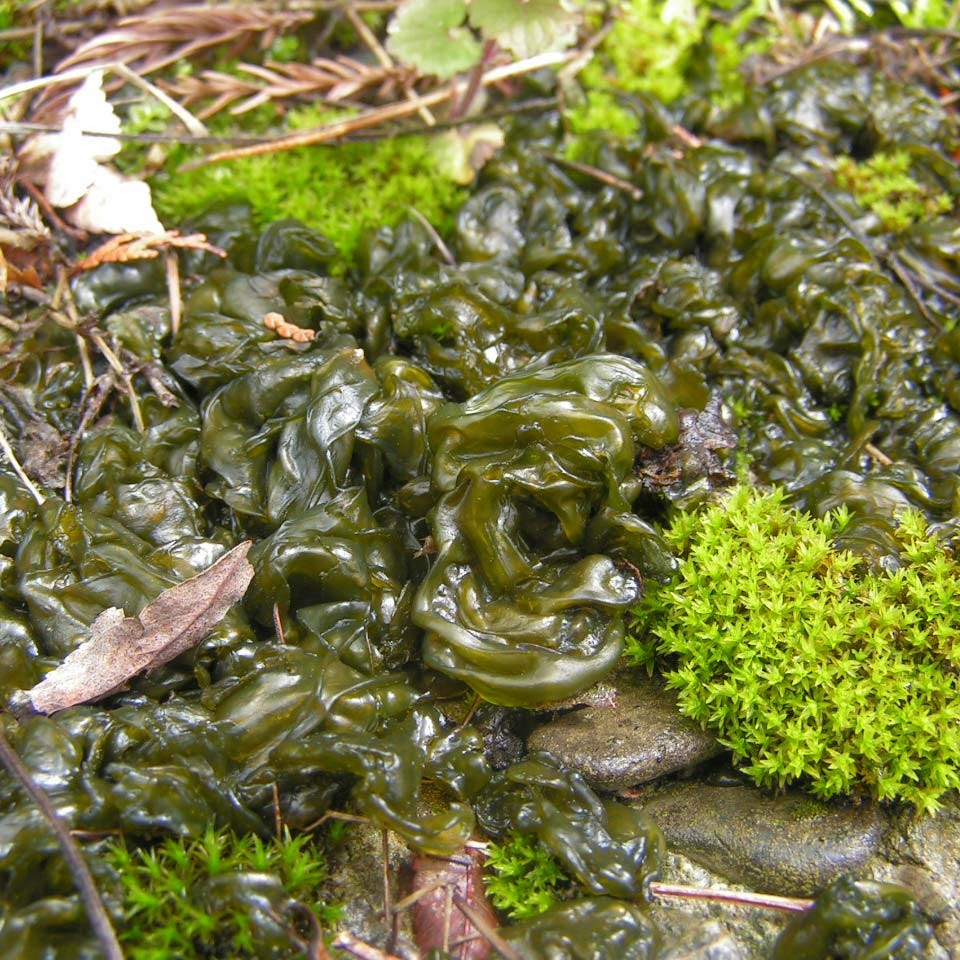
So, the majority view among the Slavs was the the clouds are made of a jelly-like-substance. Some peasants with whom Moszyński spoke, told him that they found pieces of clouds that fell from the sky and some of these peasants even tried it, as in taste it. Moszyński never saw such fallen cloud but he hypothesises, that the peasants could have been finding pieces of something that is called in Polish trzęsidło, and in English is called star jelly or witch’s butter and its official name is Nostoc sp. Nostoc is a type of bacteria that’s common in Europe. And because this star jelly looks so cool and because the whole story is in my humble opinion super cool as well, this is why the picture of witch’s butter is the artwork for today’s episode.
As to how the clouds move on the sky, there does not seem to be a consensus. Some believe that the clouds just walk all by themselves, some that they are being pulled or pushed around by people with special powers or by various supernatural beings, of which we will be talking in the future episodes.
Dew
Another thing that Slavs could not agree was where does dew come from. Some thought it fell from the sky and some thought it was the Earth sweating or that dew just walks out of the ground. Also it was not uncommon belief, especially in Russia, that the dew is actually the thing that makes cows give milk and bees make honey.
Predicting the weather
Moszyński writes a lot about the weather with a special chapter dedicated to predicting of the weather, but I don’t think that’s that important for followers of Slavic Native Faith. Maybe, other than a bit of a factoid, I guess, that in Croatia the weather could be told with flower called vremenokaz, which literally means one that tells the weather. This flower in English is called carline thistle and it was kept indoors and the weather was predicted basing on whether its petals were opened or closed. Sadly, Moszyński’s source for this information did not clarify what weather the closed petals predicted and what weather it meant when the petals were open.
And, maybe, one more thing I’ll mention, because Moszyński mentions that the ways in which Slavs predicted weather were actually tested by meteorologists and it turned out that the local predictions of local people were surprisingly accurate, but the common sayings or proverbs were actually not accurate. Moszyński explains it by the phenomenon of catchy phrases. So, as you most probably know, a lot of this folk weather-related sayings – like English “If November ice will bear a duck, all the rest is mud and muck” – they rhyme and are kind of catchy, so people just repeat it. And because they predict accurately in around 50% of the cases – which is basically as accurate as a coin toss, people will then remember when the proverb predicted accurately and will either forget or explain away when it does not. But, the local lore, held by individuals in a particular area, when the weather actually is their do or die, these individuals don’t just repeat stupid rhymes, but pay close attention to the weather, to the direction of the wind, to the clouds, to the behaviour of animals and such and basing on all this observations are able to make a decent prediction. Obviously, it is never going to be 100% accurate, because with weather it never is, but it’s got better accuracy than a coin toss.
Animals
Moszyński talks quite a lot about Slavs’ in-depth understanding of animals behaviour and anatomy, both internal and external, but I am not going to elaborate on that, since it should be obvious to anyone, that people who hunt for living, keep animals for living, slaughter said animals and process all the meat themselves, ought to know a lot about the behaviour and anatomy of the animals this people hunt, keep, slaughter and cut.
Migrating birds
As far as behaviour goes, the few things of which Slavs did not have a lot of understanding was the migrations of the birds – which is obvious, since they did not have radio or GPS trackers. So, for example, Slavs thought that swifts and swallows spent the winter in the frozen lakes – as Moszyński suspects the reason for that was that during migrations, some small birds – such as swifts – can get tired or blown away by the winds and land in lakes, where their bodies were later found by the Slavs. And another thing they did not figure out are the life cycles of some animals, mostly insects.
Butterflies
So they mostly did not know where butterflies come from. I have to admit that the stories that the Slavs told Moszyński about butterflies are super creative and could be a topic for potentially fascinating monograph. According to the stories Moszyński heard, butterflies are born like humans, or they come out of the ground, or are born out of dew, or from spider webs, or are born by various beetles, or can just fall out of the sky.
Bats
Maybe one more thing I will mention, which is quite cool in and of itself, because Slavs believed that mice can transform into bats. So, according to Slavs, bats are coming not from bats, but from mice that grow wings. And the reason why that’s cool – in my opinion, because Moszyński does not elaborate on it – is that, as you know, if you read translation on Witia’s substack – Slavs also believed that ancestors can take on a form of mice. Hence, for example, the legend of Popiel, who was eaten alive by mice in Kruszwica. I am just going to link up to this legend, as to not veer too much of the topic, and here I am just going to mention that the mice – which represented ancestors – ate Popiel after he broke the Slavic laws of hospitality and caring for the dead.
So, anyway, mice represent ancestors, and bats – as I bet you all know – is one of the forms which vampires can take. And, as you know, vampires are Slavic demons, which raise if a person with vampiric features does not receive proper funeral rites, so, from this point of view, it follows that mice can transform into bats, since ancestors – without proper funeral rites – can transform into vampires.
And this is why is so important for any follower of Slavic Native Faith to understand comprehensively Slavic point of view and cultural background. Because Slavic tradition has very consistent internal logic, which you simply can’t comprehend if you don’t know and understand the cultural context of Slavic tradition. But, again, that’s a comment from me, and now back to Moszyński.
Senses
Now I want to move to psychological phenomena, on which Moszyński writes extensively. In the category of psychological phenomena he includes subjective perception of input from our senses, such as taste, smell, hearing or vision, which kind of makes sense, because, although the reception of stimuli from the outside world is a physiological phenomenon resulting from stimulation of various receptors, the way we interpret the stimulation of this receptor is a subject of interpretation by our cognition, which makes it a psychological phenomenon.
Taste
He explains – might I say, in a really smart way, which just shows what a great thinker and writer Moszyński is – so he explains it using the perception of salty and sweet taste. I don’t know if you know – I did not know that prior to reading Moszyński – that in small concentration, salty taste can be perceived as sweet, which is a very typical quirk of taste receptors in humans and, as far as I understand, many other mammals. And it actually shows in Slavic languages because the pan Slavic word for sweet, which is soldъkъ and for salty, which is solnъ come from the same root: pra Indo-European *sald, which means salt. Gorьkъ, which is pan Slavic for bitter comes from the same root as Polish word “gorzeć” which means to burn. Kyslъ, pan Slavic word for sour, has the same root as, say, Polish word “kisić”, which means to preserve by means of lactic acid fermentation, which, as you might or might not know, is a very much Slavic way of preserving food. In Slavic cuisine there is a lot of sour things: sour cabbage, which is sauerkraut, sour cucumbers, beetroot, carrots, cauliflower, green beans, peppers, mushrooms. Slavs also sour whole, raw milk – which is called in Poland kwaśne mleko and is delicious. And, of course, you sour bread, which is how you get kwas, a type of low-alcohol beverage, very popular in Slavic countries.
Seeing
Moszyński gets though all the senses: through sounds, smell and vision. The part about hearing is super interesting, if you are into linguistics, because of all the onomatopoeias, that Moszyński lists as the etymology of many Slavic words. However, the part of about vision is even more interesting, because Moszyński points out that the pretty much pan Slavic word for knowing – like Polish wiedzieć or Russian ведать, that these words have the same root: proto Slavic *vě̀děti, which means to know by having seen. Which means that our ancestors thought that seeing is knowing. Or knowing is seeing.
That would explain – and that’s mine comment, since Moszyński does not mention it – why there are no invisible demonic creatures in Slavic mythology. There are some creatures that can make themselves invisible temporarily, but all creatures in Slavic demonology have bodies and – at least in certain circumstances or by certain people – can be seen.
From interesting bits, while talking about vision Moszyński does mention that the root of pan Slavic names of shades of blue and gray is the word sinъ, which actually originally meant bright as in bright light of bright white colour, which is just another way of showing how subjective the perception of our senses Is: some people see blue, some see white and some see gray and we can all see it in etymology of Slavic languages.
But, where I am going with it – following Moszyński’s reasoning – is that Slavic language is deeply rooted in the bodies of the Slavs. The words that describe perceiving the reality can be traced back to how we actually perceive reality with our senses, including the common root of the words describing the sweet and salty taste, because at low levels of saltiness, what we perceive is actually sweet. This strong bond between the Slavic language and the way the reality is perceived with our senses is even more obvious in the way Slavs talked about emotions.
Emotions
Discussing Slavic vocabulary for emotions Moszyński makes 2 things clear: 1) is that a lot of Slavic words describing emotions are, basically, pan Slavic and have not changed much since the times the pre-Slavic language was spoken, and 2) is that pretty much all Slavic vocabulary related to emotions describes, literally, how emotions feel within the body.
So we have the verb “sierdzić się” or “sьrditi sę”, which means to be very angry and it originates from sŕ̥dьce, which literally means “this which is inside” and is also a pan Slavic name of the heart. Also, the “się” or “sę” in the verb “sierdzić się” or “sьrditi sę” indicates that the verbs are reflexive, so the action expressed by the verb is directed to the same person or thing that performs the action. So, basically, in Slavic understanding, if you are very angry, you doing something to yourself with your insides or with your heart.
Then you have pan Slavic “gniew”, which means severe anger, like wrath or fury. The noun “gniew” has the same origin as the Polish verb “gnić” – which means to rot and it is suspected that originally it meant poison, but not like arsenic or hemlock, but like the poison in food poisoning, so the toxins that are produced when something is rotting. So, basically, in Slavic understanding, severe anger is like rot or poison. If you cultivate such poison – as expressed in the verb “gniewać się”, which let me remind you, has “się” in it, so it’s a reflexive verb. So, if you cultivate gniew, so severe anger, you are poisoning yourself.
Another verb for anger is “żołądkować się”, which originates from, also pan Slavic word *želǫdъkъ, which is the stomach. Again, very easy to spot the meaning: to be angry is to do something to yourself with your stomach.
And then there is – again, pan Slavic – *zavistь, which means envy. It is a compound noun, made up from a prefix *za- and the verb *viděti. *viděti means to see and the suffix *za means in various senses behind, beyond, for or after. So in Slavic languages envy means to literally look at something for too long and look at it after it passed you and left you behind. Which is, really the definition of envy. Is the feeling that you get when you see something that’s not yours or is out of your reach and you can’t have it. The noun *zavistь is the root of many other words, like Polish zawistny or Russian завистливый, which means envious but also spiteful and, generally full of hate. And it is all from looking too long at something that’s beyond your reach.
We get pretty much the same picture when we look at vocabulary describing nice things, like Polish przyjemny or Russian приятный, which both mean nice or pleasant and both come from the same Proto-Slavic root *ętì, which means to grasp with a preffix przy- or pri-, both meaning at or close to. So something that is nice or pleasant is something that you want to grasp, to bring close and keep near – because it’s nice or pleasant.
Another one, but, kind of going the other way around, is the name of rainbow in Slavic languages. In Russian for example rainbow is called радуга, which comes from proto-Slavic *ràdъ, which means joy. From the same root, *ràdъ, radość – Polish word for joy is derived. In Ukrainian rainbow is called веселка, which comes from proto-Slavic *vȅselъ, meaning joyful. In pretty much all Slavic languges proto-Slavic *vȅselъ is the root of an adjective wesoły, which means joyful and the noun wesele, which means wedding. So, in Slavic languages – with exception of Polish and, I think, Sorbian – a rainbow is the cause of joy or of being merry.
As a factoid I will add – from me, not from Moszyński – that Polish and Sorbian languages name rainbow after proto-Slavic *tǫča, which means a thundercloud. Because, you know, we, Poles, are such an insightful and retrospective nation, that even in the rainbows we saw, in retrospection, the thunderclouds that preceded it. But that’s my comment, and I am getting back to Moszyński momentarily.
The ways of knowing
I know you are most probably fed up with all this etymology, but I really, really have to mention one more thing, namely, the Slavic concept of cognition and memory, which will require me to continue digging in etymology. But there is a point in it, so just bear with me.
If you look at Slavic vocabulary related to cognition and memory, there are 2 core, pan Slavic roots: proto-Slavic words *mętь which means a thought and *ũmъ, which means mind. To the latter word, *ũmъ, so mind, the proto Slavs added prefix *orz, which indicates division or separation, to have a proto-Slavic *orzumъ, which means reason or intellect.
BTW, I am going to add here, that the proto-Slavic *orzumъ went through the process of common Slavic liquid metathesis, which is a process of swapping sounds around, which gave the pan-Slavic rozum, which still means reason or intellect.
As far as the proto Slavic *mętь, so thought, proto Slavs added prefix *pa, which indicates that something is after or later, to have a proto-Slavic *pamętь, which means memory. So, according to our ancestors, to remember is to have a thought later or after, and to reason is to use your mind to divide or separate.
Moszyński shows it beautifully by analysing his conversations with the pre-industrial Slavs, who divided the mental processes of humans into 2 separate categories. The first category, related to *pamętь, so to memory, is a concept of oneself, the state of being aware that one exists. The second category, related to *orzumъ, so to reason, is the ability to comprehend, to think, to reason. And Slavs understood that a human can have both: *pamętь and *orzumъ, can have only one of them or can have none.
So, children and stupid people don’t have the *umъ-based ability, they don’t have reason, are not able to think properly. People who are unconscious or overtaken by severe affect – like gniew, so anger – they don’t have the *mętь-based ability, they don’t have the thoughts, the awareness that they exist, or they don’t have the *pamętь, so the ability to retain the thoughts for long enough to remember it, which, if you look at it from a 3rd person perspective, is pretty much the same thing,
According to Slavs the *umъ-based ability is something that can be acquired – which is how children acquire reason as they grow up. But the *mętь- or *pamętь-based ability is something that one can only lose – as one gets older for example, or regain – as one manages to overcome for example, severe anger, but one can’t just learn or acquire *pamętь. One either has it or not. What more, there is a relation between the *umъ or *orzumъ, so the mind or intellect and the *mętь and *pamętь, so the thoughts and remembering them. If one takes too much in one’s *pamętь, so the concept of oneself, then the *orzumъ, so the reason, will get confused. Which suggest that the *pamętь, the memory based awareness of one’s existence is primary and the *orzumъ, the ability to reason is secondary. Which is confirmed in how Slavs saw the cognitive abilities of animals, who, according to Slavs had the *pamętь, but did not have the *umъ.
Slavs also had the distinction – not known in Eglish – between the knowing related to *pamętь, to remembering and the knowing related to *umъ, to reasoning.
The knowing related to *pamętь is of 2 kinds. One is the mentioned earlier knowing related to seeing, like in Polish wiedzieć. And second is knowing related to recognising, which originates from proto-Slavic *znatь, which is the root of pan Slavic *znakъ, which means a sign or symbol. In Polish the knowing related to recognising is “znać” in Russian is “знать” and as far as I know, it is pretty much the same or very similar in other Slavic languages. But, both seeing and recognising types of knowing, the “wiedzieć” and “znać” require *pamętь, so memory, to exist.
The *umъ related knowing is of one kind and requires application of reason. It is knowing by understanding, by knowing how and it is also a pan Slavic concept, reflected in, as far as I know, all or nearly all Slavic languages.
Moszyński also talks a lot about the Slavic concepts of being crazy, stupid or mistaken, which seem to be more of a spectrum of one phenomenon that 3 distinctive states. So, in the Slavic way of thinking about thinking, the difference between being mistaken, stupid or crazy is a matter of degree and a matter of how long this, let’s call it, condition last. To explain it very quickly, it’s all about the contact with reality, one has. If one is only, say, seeing something that’s not there, or not recognising it properly, this person might just be mistaken, if seeing something that’s not there last only short period of time. But if one sees things that are not there all the time or is not recognising things properly all the time, that would indicate being crazy or stupid, with the distinction between crazy and stupid being very, very vague and undefined. So for the Slavs mistaken, crazy and stupid are not 3 separate categories, which is also reflected in Slavic languages as well in the explanations that Slavs gave to Moszyński when he interviewed them.
Witia’s conclusions
And that is it with regards to the summary of pages 41-97 of Kultura Duchowa by Moszyński. As in previous episode, before I end, I’d like to highlight some points that I think are important and I fear I might have not stressed enough in today’s summary.
While reading Moszyński it is absolutely clear that the mental, psychological functioning in the Slavic way is deeply embodied, rooted in experience and empathy driven sharing of reality. When talking about sensations Slavs use vocabulary that directly relates to the sensations with and within the body and this vocabulary has been understood and shared as a common language through time, space and generations. I only brought up a few examples in this episode, but Moszyński writes nearly 30 pages about embodied etymology of Slavic emotions, senses, cognition and memory, making it crystal clear, that the Slavic way of life is to live in your body, with your body and by your body. For the Slavs there is no Cartesian mind-body separation, there is no mind that only needs body for the purpose of locomotion as the ancient Greeks saw it. The Slavs are present, they are embodied, they feel even if it poisons them with rot from the inside. They are aware that emotions can take away their reason, their *umъ, but they feel their emotion anyway, because this is how you get through life as a human being, not a drugged up zombie, of which I talked extensively in the 3rd episode of the 2nd season of Searching for the Slavic Soul, so I will not be talking about it now.
And the second conclusion of reading Moszyński is, as I already mentioned it, but will repeat it anyway: Slavs see the world as an organism, not as a machine. If you want to follow the path of our Slavic ancestors, you simply have to stop looking at the world as at a collection of parts and elements that can be used and abused. The water is not a commodity. It is a living being that can be awaken, get lost in thoughts or experience fulfilment. The clouds are not a part or a machine that can be seeded or exploited. It is a living thing, that can walk, break, fell down and even be tasted. The winds can get angry, scared or have an argument, they are not just a resource to be utilised. And we, humans, are not some sort of walking minds that can be swapped around. As every single thing in the world of the Slavs, we are alive and organic: we see, feel, taste, we remember, we understand and we are able, with enough presence in the world, befriend and understand the world around us to such extent, that we can predict and anticipate the moods and inter-personal drama of the winds, the clouds and even the lost in thought seas.
And yet again I talked today longer than I planned and I am not even sorry, because I do think that Moszyński is important to know for every single aspiring Rodnover out there.
In the next episode – in one moon – I will be talking about Slavic mathematics and hopefully I get to medicine too. And for now, thank you for listening and see you next time.
Sława


