

In this episode: summary of pages 265 to 298, discussing basic rules and types of Slavic magic
Caveats:
This entire third season of Searching for the Slavic Soul is a detailed summary of Kazimierz Moszyński’s monumental work Kultura Duchowa Słowian (Spiritual Culture of the Slavs). Everything I present in these episodes comes directly from Moszyński’s research and analysis. Whenever I add my own thoughts or commentary, I will clearly mark them as such.
When Moszyński speaks of “the Slavs,” he is referring to the pre-industrial rural Slavic populations he studied through fieldwork at the beginning of the 20th century. So whenever I say “the Slavs did this” or “among the Slavs it was common that…”, I am also referring to those same pre-industrial rural communities, not to all Slavs throughout history or to modern Slavic people in general.
Transcript below
Sława, everyone. Sława Bogom and welcome in the 6th episode of 3rd season of Searching for the Slavic Soul. If you listened to the earlier episodes you know that in the season 3 I am summarising the 2 volumes of Spiritual Culture of the Slavs by Kazimierz Moszyński and today I will summarise pages 265 to 298, which is roughly half of the chapter 8, titled Magia, which means magic.
There’s some caveats to the content of this episodes, but I can’t be bothered to repeat it for the sixth time, so I put it in the notes to this episode, so make sure you read it.
The rules of Slavic magic
As to the pages we are summarising today, I am just going to get into it because there’s a lot of material to go through today. Moszyński starts with explaining the core features of the Slavic world-view regarding how things interact with each other. The are 6 main features here which are:
1) The range of action of an object is much wider than the object. For example, salt will not only blind someone if it’s thrown into the eyes of this someone, but also when it’s near this someone who is to be blinded.
2). Words, thoughts and actions are much more powerful that they seem to be. For example, just thinking or talking about something can cause immediate manifestation of this something.
3) Properties of an object extend to any object that is or can be associated with it. For example, sheep’s wool will behave towards wolf’s fur exactly the same as sheep behave towards wolves.
4) Every single property of an object has the same physical properties as, say, thermal energy, and therefore every single property of an object can be transferred from this object to another object. For example, knowledge contained in a book can be transferred to, say, a newborn, if the book is carried around the newborn, just as carrying a something warm around a newborn would result in the thermal energy warming up – so being transferred to – the newborn.
5) The transferring of these properties can be achieved not only via touching or bringing close the object, which properties we want to transfer, but also via walking over the object, throwing the object above, or jumping over the object, or carrying the object around or walking around the object.
6) In the world there are not only the regular, visible and touchable, the physical beings, but there is also plenty – and I mean: plenty – beings that might not be easy to see or are most of the time invisible, but they nevertheless have every single property of a regular, visible and touchable, physical being.
Apart of these 6 features of Slavic world-view, there is also one, fundamental rule of Slavic magic, which is: what you do is not as important as what you think you do. So, for example, if you hit a person thinking that you hit a disease sitting in this person, you are actually hitting the disease, not the person. Also, because the thought is more important than the deed, the exactly same thing done in Slavic magic can have totally different purpose and totally different outcome, entirely depended on what the person doing the thing thinks he or she is doing. For example, rolling an egg on someone body might result in transfer of the life from the egg to the body of this someone, if this is what the person doing the rolling thinks he or she is doing; or can result in getting a disease of the body on which the egg is being rolled, if this is what the person doing the rolling thinks he or she is doing.
As far as the practices in Slavic magic, other than the obvious active and passive, there is translational magic, which transfers properties; transmissive magic, which transmits action through the space – and time – at whomever or whatever the magic is aimed; sympathetic magic, which acts on the object of magic via either acting on a random object, or via either acting on an object related or similar to the intended object; there is creational magic, which creates something by becoming like this something, or creating objects similar to this something; and the last practice in Slavic magic is inceptive magic, which aims at initiating a future action or state by magically initiating it.
From what Moszyński writes, in Slavic magic thoughts, words and actions are kind of adding up, so if you just think something when doing magic, it will not be as powerful as thinking it and saying it out loud and that in turn is not going to be as powerful as thinking it, saying it out loud and actually doing it while doing magic.
Para-magical practices
Moszyński also briefly mentions para-magical practices, which are practices that are consider magic, because of the underlying thinking, but otherwise potentially make sense, or would have made sense if they were directed towards not-supernatural objects. Such practices were mostly discussed 2 episodes ago, when we were talking about Slavic medicine, in practices as sucking out or washing off a disease. But another para-magical practice – which was not mentioned 2 episodes ago – is a practice of dragging – mostly children, but also grown ups that are very weak – though something in order to free the children and grown ups from whatever ails them. The dragging can be done through a live, freshly split in a half tree, through a sort of ring made out of bend branches of a tree or other plant, through spaces between a branch and the trunk of a tree, through spaces between slats in a fence or even through the empty middle of a ring-shaped cake. As far as trees, if they are used to drag the child or a weak grown up through it, an oak is by far the most popular, but in some regions of the Balkans a bush of dwarf elderberry is preferred.
A version of dragging through is driving through a herd of animals, such as pigs or cattle through a tunnel, typically dug into a low slope of a hill, with fire burning at both ends of the tunnel. Often juniper is put into the fire to increase the effect of the procedure.
Moszyński is not sure what is exactly the purpose of the dragging through. It could be to make a magical contact with the healthy tree and thus pass the health from the tree to the dragged person. It could be passing the strength of the tree onto the person. But it could also be an attempt to remove the disease or whatsoever is ailing the person – or animal – through dragging him, her or it through the hole, ring or tunnel. He cites the words said out loud during such rituals, which are: “Holy tree, green oak, take away his tears, cast them off him, grant him health”, which kind of implies the former and the latter. But Moszyński also gives another example of apparently quite popular custom of Slavic beekeepers, where they seek to acquire a larynx of a wolf and if they get it, they put in on the exit from the beehive in such way, that bees have to fly trough it when flying in and out of the beehive, believing that the wolf properties of the wolf’s larynx will pass on the bees and because of that the bees will be stronger and will be attacking other beehives, steal the abundance from them and bringing the abundance back to own beehive. So, Moszyński hypothesises, that through dragging or driving through a transfer of properties other than health might also be happening.
Another para-magical practice is making noises to scare off all sorts of supernatural things. The noise can be made by screaming, shooting guns, clanging of metal objects, honking, ringing of bells, tapping and clattering of rattles, whip cracking, or even animal noises. The making noises is done to chase away witches and demons, including demons pushing or driving hail clouds into a village.
Fighting dragons
Here Moszyński describes a custom which was recoded in Serbia, in 1908, on the night of 21/22 of July, in a village of Veliki Izyor near Crna River. And this custom is so cool, that I am going to briefly summarise it too, even though is not strictly speaking magic.
So, as you might or might not know, in Serbia, and, as far as I know, generally among Southern Slavs there is a belief that żmije (zmeys), so Slavic dragons, fight with demons that bring storms. So żmije are seen as beneficial, but sometimes it could happen that a żmij took liking a particular place, like a village, and got asleep in this place. And żmij sleeping in a particular place scared off all the rain from this place – because the demons that bring clouds stayed away. So, if there was a drought in a village, it meant that a żmij slept there. So the żmij had to be chased away. And the chasing away happened on the night of 21/22 of July in 1908 in the village of Veliki Izyor and was recorded.
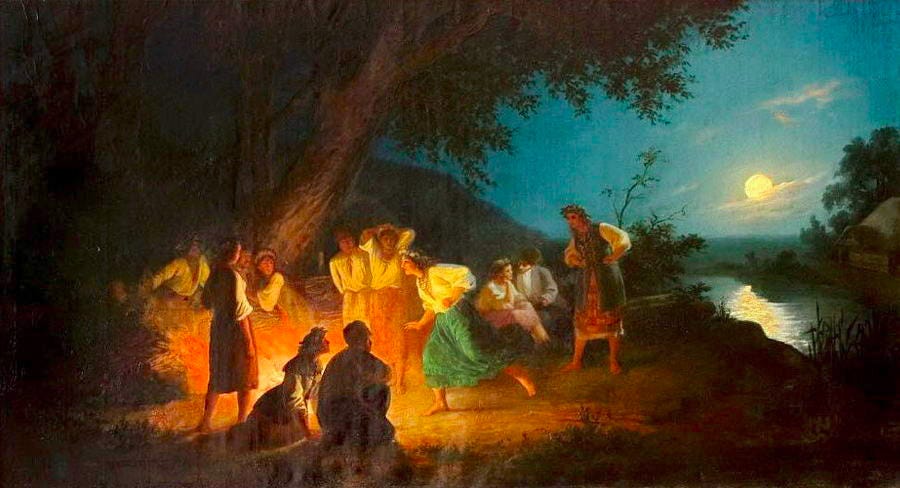
So, at the end of the day all the women, children and elders hid in their houses. All the animals were safely locked away. And after sunset all the men from the village gathered in the cemetery outside of the village and started a bonfire there. Then they undressed and started dancing around the fire a dance that’s called vrzino kolo. They danced in complete silence until they collapsed from exhaustion. And after that they got up on their feet, and run to the village screaming, shouting, making terrible noise by beating on metal vessels, clanging with roasting spits and various other metal tools. They run thought the whole village, through every single nook and cranny, to chase the żmij out and direct him to the fire, where they trapped the żmij with another dance of vrzino kolo, until the żmij left the village through the fire.
And, now – let me comment on it some more – this whole thing happened at the end of July, so which is peak harvest. These men laboured in the fields every day, 7 days a week, from sunrise to sunset, for weeks. And on top of that, after a whole day of work, after sunset they danced naked until exhaustion – twice – and on top of that, run through the whole village, naked, with only some pots and roasting spits in their hands to chase away a dragon. This is peak masculinity, people. This is what Slavic men have been doing since the first Slav was born: they have been working together, using their strength, their bodies, everything they have and more, to protect women, children and elders from every imaginable and unimaginable harm, including protecting them from Slavic dragons. They’ve been doing it for the whole village. For people they liked and disliked, for people they respected and disrespected. Even for families of some other men who they might not even liked. They did not do it to preserve their own bloodline or their wealth, but to protect everyone. That is what Slavic men do. That is what Slavic men are: strong, resilient, committed, determined and so bloody brave that they stand up – naked – to a dragon and the dragon runs away.
And, that was obviously my comment and now: back to Moszyński.
Non-Slavic magic wands
Making noise is not the only way of chasing away supernatural beings. Beating is also widely used – as it was discussed in the episode on Slavic healing, where beating the patient in order to beat the disease that sits inside the patient is one of the most common way of healing. But beating can be used also to chase away supernatural beings that have not caused a disease yet, or supernatural beings that cause bad luck or such. While discussing this topic Moszyński makes a very important observation, namely, that a wand that in itself has magical properties is not an original part of Slavic tradition. Magic wands – that are used to touch objects in order to transfer magical properties onto the objects – are of Germanic origins. The original Slavic concept is either a staff or stick used to beat/scare/chase away supernatural beings, or a a twig or a bunch of twigs of a particular plant, that’s used to either sweep away the supernatural beings, or is used to stroke, say, an animal, to transfer particular properties of this particular plant. So, bunch of willow twigs or stinging nettles – so, essentially, brooms – are used to sweep around the house to chase away malevolent demons. Or a willow tree with catkins – and that’s important, because it’s not about the willow, but about the catkins – is used to stroke an animal to transfer to the animal the roundness, softness and fullness of the catkins.
So – and this is my comment not Moszyński – if you ever hear, read or watch any content about magic wands used in Slavic magic (and there is a lot of content like that out there) you can be certain it’s 100% Germanic influence and not a part of authentic Slavic magic. Magic wands used to cast spells or to direct magic are just not a part of the original Slavic tradition.
Cheating as magic
The last form of para-magical practices are attempts to cheat or mislead the supernatural beings in order to protect, typically a child, but sometimes a grown up or an animal. The most common example of such practices are calling children ugly names, to convince malevolent supernatural beings that the child is not worth their attention. A less known example is pretending to sell a child – typically to a relative or a neighbour – so the child is perceived as not belonging to his or her parents or to the household. Another example from Bulgaria, Serbia, Montenegro and Herzegovina is announcing a birth of a son, by cracking a whip (to scare away malevolent demons) and saying out loud not that the mother gave birth to a son, but that she-wolf has given birth to a wolf. Such practice was supposed to protect both the mother and the son.
As to practices that Moszyński considers actual magic, he starts with scattering, typically seeds, which is done for many purposes, one of which is to transfer the life from the seeds to the object of the magical ritual. So, seeds are scattered or thrown at newly-weds or at a new house. But they are also thrown at the dead, to neutralize the death in the dead with the life contained in the seeds. Scattering seeds, particularly poppyseeds, is used in protection magic against malevolent spirits of the dead, because it is believed that the dead will have to pick up all the seeds on their way before moving forward. This practice stems from Slavic belief that the dead are akin to birds, so from this it follows that if you scatter seeds, the dead – as birds – will stop to pick up all the seeds. However, and it is my comment, not Moszyński, partially because the concept of OCD was completely unknown in the times of Moszyński. But, from a perspective of 21st century, when you read about Slavic protective magic, there is a distinctive OCD feel to it. I’ll be talking about it more later in this and the next episode, but here just want to signal the OCD tropes I’m seeing and you can make up your own mind, if you are seeing it too. And now, back to Moszyński.
Translational magic
Let’s move now to proper magic, starting with the first type that Moszyński discusses, which is translational magic, which, hopefully you remember, is used to transfer – in a magical, not as Moszyński calls it, a rational way – properties from one object or living thing to another. The techniques used in such type of magic are totally pan-Slavic and are very important element of Slavic magic, used all over the Slavdom. These techniques involve stepping over, jumping over or throwing something over, as well as walking under an object.
I called them techniques, but they are kind of perceived by Slavs more like the regular ways in which properties are transferred and then the knowledge of such ways is used in Slavic magic. So, say that you walk over a dead body. In Slavic way of perceiving the ways of the world, doing such thing will automatically – whether you want it or not and whether you think about it or not – transfer your life to the dead body and the death or disease of the dead body to you. Hence, stepping over a dead body is a huge taboo in Slavic tradition, because no one wants to give life to the dead. And, obviously, no one wants to acquire death or disease. So, because properties transfer when your way crosses over with the way of something else, be it by stepping over this something else, jumping over it, walking under it or throwing it over you, Slavs are super mindful of where they step and over what. For example, if a bride steps over a broom instead of walking around it, her husband will for sure treat her disrespectfully, which… now I see it does not make much sense in English, but, in Polish, it makes total sense, because a broom is ‘miotła’ and to treat someone disrespectfully is ‘pomiatać’. Both words ‘miotła’ and ‘pomiatać’ come from proto-Slavic *mesti, which means ‘to throw, to toss, to sweep up or to clear away’. So, according to the rules of Slavic magic, the broom and being disrespectful is the same, because it comes from the same word.
Slavs are also very careful not to step over or otherwise cross their way with all sorts of lines for whatever reason present on the ground, because it’s a sure way to get skin break outs. It might not be as bad as ‘step on a crack break your mother’s back’, but the principle is that same, isn’t it? Based on this principle there is a lot of prohibitions put on pregnant women, who are not allowed to step over animals – to not to transfer the properties of the animal into the child or over any sort of cut lines, for example a cut in a threshold left by an axe, so the child does not get a hare lip. I mean, is it only me, who sees the OCD tropes here? Am I making it up?
The rule of transferring of properties by steeping over it is used on purpose in Slavic magic, to transfer properties for own benefit. The obvious example is jumping over a bone fire during Kupała, to transfer the abundance and strength of fire into you. Another example is a procedure that’s done if you want to transfer property of abundant milk production from the cows of your neighbour to your own cows. If you want to do that, you put bread crust on the way of the herd of your neighbour and after the neighbour’s cows stepped over it, you give the bread crust to your cows to eat. Or, if, say, a sheep does not want to nurse own lamb – which Slavs say that the sheep does not like the lamb – the sure way of making the sheep like the lamb again is to get two brothers to kiss each other under the sheep, which in a way forces the sheep to step over the brothers that like each other and in this way the property of liking own kin is transferred from the brothers to the sheep.
Similarly properties can be transferred by going through something or walking in circles around something – of course, walking with the Sun, which, as I explained in the 1st episode of the 3r season, is walking around something clockwise. For example, if a woman does not want to have any more children, all she has to do is to walk 3 times around a barren tree and in this way the property of being barren will transfer from the tree to the woman.
Transmissive magic
The next type of Slavic magic is transmissive magic, which transmits magic through space and time. That’s commonly done via wind or water – for example spells are cast into the wind or water and the elements are obliged to deliver the spell to the intended target. Although, sometimes the spell will miss the intended target and such stray spell can hit a random person, animal or household and do harm there.
Oh, because I forget to mention that in Slavic tradition, spellcasting – known as czary (чары), which comes from proto-Slavic *čarъ, which means magic or sorcery – is using magic to do harm, either maliciously, just to hurt, or egoistically, to get the benefits for oneself. Which, obviously, and that’s my comment, not Moszyński, debunks all the fakelore BS stories about white and black Slavic witches or white and black Slavic magic, because Slavic spellcasting is, by definition, exclusively malevolent. The benevolent Slavic magic does not involve spell-casting, but either zamawianie so talking to the malevolent being to convince it to go somewhere else, or chasing/beating/scaring the malevolent being away.
As to transmissive magic, which could transmit czary – so magic spells, which, let me remind you once more, in Slavic tradition are always malevolent – through space. Apart of using water or wind, czary could also be transmitted via horns, like oxen horns, with a hole on the tip. The spellcaster, so czarownik or czarownica, filled such horn with sand, gravel and broken glass, and then used the horn to blow it all, together with the cast spell, toward the target of czary. Such type of czary caused strèły, so pneumonia. Moszyński cites the spells used in such magic, but I will not be saying them out loud, because, being a Rodnover, I firmly believe in the power of Slavic słowo, so in the power of Slavic word. But in English such spell would translate as something along the lines of: ‘Go to the one on which I am casting the spell, shoot him in the heart, dry him, burn him, send him to his grave’.
The transmissive magic can also work in time and also if the location of the target is not known. This rule Moszyński illustrated describing a Belorussian protective ritual for cattle, which includes casting spell on wolves. This ritual is done when the cattle is first driven to the pastures and is supposed to protect the herd through the whole grazing season. The cattle is gathered on the pasture and circled around three times by the shepherds. Then the oldest shepherd says a prayer, asking God to grant the cattle safety from harm, including harm from predators, and after that all the shepherds turn around, back to the cattle and face to the field, and start screaming like they are chasing away wolves. One shepherd cracks a whip, the oldest shepherd shouts: ‘Sol žnu v voči’, which means: ‘I throw salt in your eyes”, while at the same time another shepherd actually throws salt into the field. Then the oldest shepherd shouts: ‘Hyływńa žnu u zuby!’, which means ‘I throw a torch in your teeth’, while at the same time another shepherd actually throws a torch into the field. So, you see in this ritual, which BTW was performed by Christians, who attended church on Sunday and everything, that all the rules of Slavic magic are applied to strengthen the ritual: thoughts, actions and words are used together, in the same goal.
Sympathetic magic
Next is sympathetic magic, which Moszyński – forever the critical thinker and the sceptic – calls proper magic, because it makes no sense. This type of magic, let me remind you is used to acts on the object either by acting on a random object, or by acting on an object related or similar to the intended object. This type of magic beautifully illustrates the fundamental rule of Slavic magic, which says that what you do is not as important as what you think you do. Here we have very common practices as reversing something to reverse evil, as in evil eye. So, if you think you’ve been affected by an evil eye, all you have to do is to reverse something: like turn a pot upside down, or turn a picture back to front, while thinking about reversing the evil eye and that is enough to reverse the evil eye.
All sorts of malevolent beings or influences can also be thrown away. Here Moszyński gives an example of what people do, if they have to refuse a pregnant woman. If you don’t know, in Slavic tradition refusing anything to a pregnant woman is taboo, which if you break it, it will bring all sorts of malevolent effects on you. So, if you have to refuse a pregnant woman, when she walks away from you, you need to throw something after her. It does not matter what it is. It can be a piece of coal or some dirt, but you have to throw it after her, to throw away the evil.
Another example of such magic is breaking things to break whatever malevolent influence is ongoing. This is why, for example, pots were broken when a dead body was carried out of the house. Another one is magical closing of, say wolf’s jaws, by closing a padlock during the opening of grazing season. BTW, a different way of closing wolf’s jaws is by getting an axe or a knife stuck in something, which is a way of ensuring that wolf’s jaws will get stuck too. This is why, if a sheep got lost so late in the day that there was no time to find it before sunset, the shepherd would drive an axe into a tree and will not take the axe out until the morning, to ensure that he wolf’s jaws will be stuck as long the axe is stuck, so the sheep will be safe.
Yet another way is to saw something together, which was done by women in Bulgaria. A women will grab the corner of her, say apron, and start sawing it together. That had to be done in the presence of another person, who had to ask: what are you sawing?. The woman would reply: I am sawing the wolf’s ears, so they can’t hear the sheep, the goat, the cattle etc. Then the pattern of questions and answers would have to repeat another 2 times, and the 2nd time the woman would reply that she is sawing the eyes and the 3rd time that she’s sawing the jaws of the wolf.
Similar to sawing is tying a knot, which is a huge element of Slavic magic, used in both protective magic and in spell-casting, which, let me remind you: in Slavic magic is always malevolent. So, you could tie a knot on someone’s wheat to cause all sorts of bad things to happen to the owner of the field. But you can also tie a knot by your, say, belt to protect you from such spell, because you’re tying the spell before it’s cast. And because a knot – tied for protection – was used in protective magic, a fishing net – an item made entirely out of knots – was sometimes used as a sort of a barrier against spells and used, say, to cover brides.
By this logic, untying or opening is used in Slavic magic to either undo a spell, or to facilitate opening or passing, in childbirth for example. Among Eastern Slavs it’s customary to open everything: cabinets, chests and untie everything, including combing through the pregnant woman’s hair, to facilitate easy childbirth. And if childbirth is particularity bad, it’s not unusual for the peasants to ask the priest to open the door behind the altar in the church, which is a sure way of granting the passage of the child into the world.
In sympathetic magic relations – of the objects and the actions – is everything. Also objects that are part of larger entities are believed to have the same properties as the larger entities. So, in Slavic magic, a hawk’s feather is the same as the hawk and a chicken feather is the same as the chicken. Hence, widely spread belief, that if in one duvet chicken and hawk’s feathers are put together, the chicken feathers will run away from the hawk’s feather and the duvet will therefore forever be loosing the feathers.
Similarly, your hair is the same as you, so if a bird gets hold of your hair and makes a nest out of it, you will have headache for the whole time the nest is in use. So, as you can guess, Slavs were careful about not losing hair in places where birds or malevolent beings, including your neighbour, could get hold of your hair, because that could result in your harm.
But, the positive sidet of this aspect of Slavic magic is that if you get robbed, but managed to get hold of a piece of clothing of the robber, you could proceed to torture the piece of clothing and that would cause harm to the robber. Moszyński gives several examples of such events, including one report where the thief, who stole honey, actually got ill and died after his coat, which he left at the crime scene, was severely flogged.
And I am going to stop here, on the page 298, where I’ll pick up next time, to finish discussing the creational and inceptive magic, talk more about spellcasting, and if there’s time maybe about practising trance, as in inducing trance via dancing or singing.
Witia’s conclusions
But, before I end, as it’s become customary, I’d like to make some more comments to make sure that I highlight the bits that are, in my opinion, most relevant to modern practice of Slavic Native Faith.
The most important thing, in my opinion – other than the fact that Slavic men are awesome – is the power of thoughts, words and actions working in unison: they literally, if put together to the same goal, are the core of Slavic magic. And I think that modern Rodnovers should be mindful of that when living their lives and particularly, when striving to achieve a goal.
So, following the lessons of Slavic magic, make sure that what you say you want is what you think you want, and what you do to achieve it is in sync with your words and thoughts. If you, for example, say that you want to have a family, but do not do anything in order to build one and keep the one you have together, and at the same time think badly or with resentment about a member or all members of your family – do not expect your family to last. It simply can’t, because your goals are torn apart by your thoughts, words and actions pulling in different directions.
Same applys to your religious practice. If you engage in, say, a dziady celebration, be it at home or at the grave of one of your ancestors, but don’t actually think that the ancestors are there with you, don’t expect the celebration to have particularly powerful spiritual, or any effect, really. You want the effect to be for your ancestors to get involved in your life, to get the supernatural wheels going on your behalf. But you can’t expect them to be bothered to do it, if it’s all make-believe for you, can you? Would you want to help someone who does not even believe that you exist? If you don’t believe that someone exist, this someone, if he or she exists, is by definition, a stranger. So don’t let you ancestors be strangers to you. Believe that they are there for you and then: let the magic happen.
And that’s it for today. Next time, in the moon of heather, we will talk some more about Slavic magic. And until then, take care of yourself, respect your men, and get your thoughts, words and actions in sync.
Sława!


